Overview
The common merganser (Mergus merganser) is a duck found across North America, Europe, and Asia.
Known in Eurasia as the goosander. It’s one of the most striking and powerful diving ducks-sleek, fast, and built for life on clear rivers and deep lakes.
The common merganser is a big, streamlined duck with a long, thin red bill designed for catching fish. It nests in tree cavities, often far from water, and ducklings famously leap from the nest within a day of hatching.
Distribution & Habitat
North America: Found year‑round in the Pacific Northwest and parts of the Northeast; elsewhere mostly a winter or migration visitor.
Europe & Asia: Widespread across northern regions; known as the goosander.
They prefer to live near Clear rivers, large lakes, and reservoirs: Forested regions with suitable nesting cavities, and Winters as far north as open water allows.

Adult Male
Mostly white body with a green‑black head
Black back, white inner wings
Long, narrow red bill
Sleek, powerful profile
Adult Female
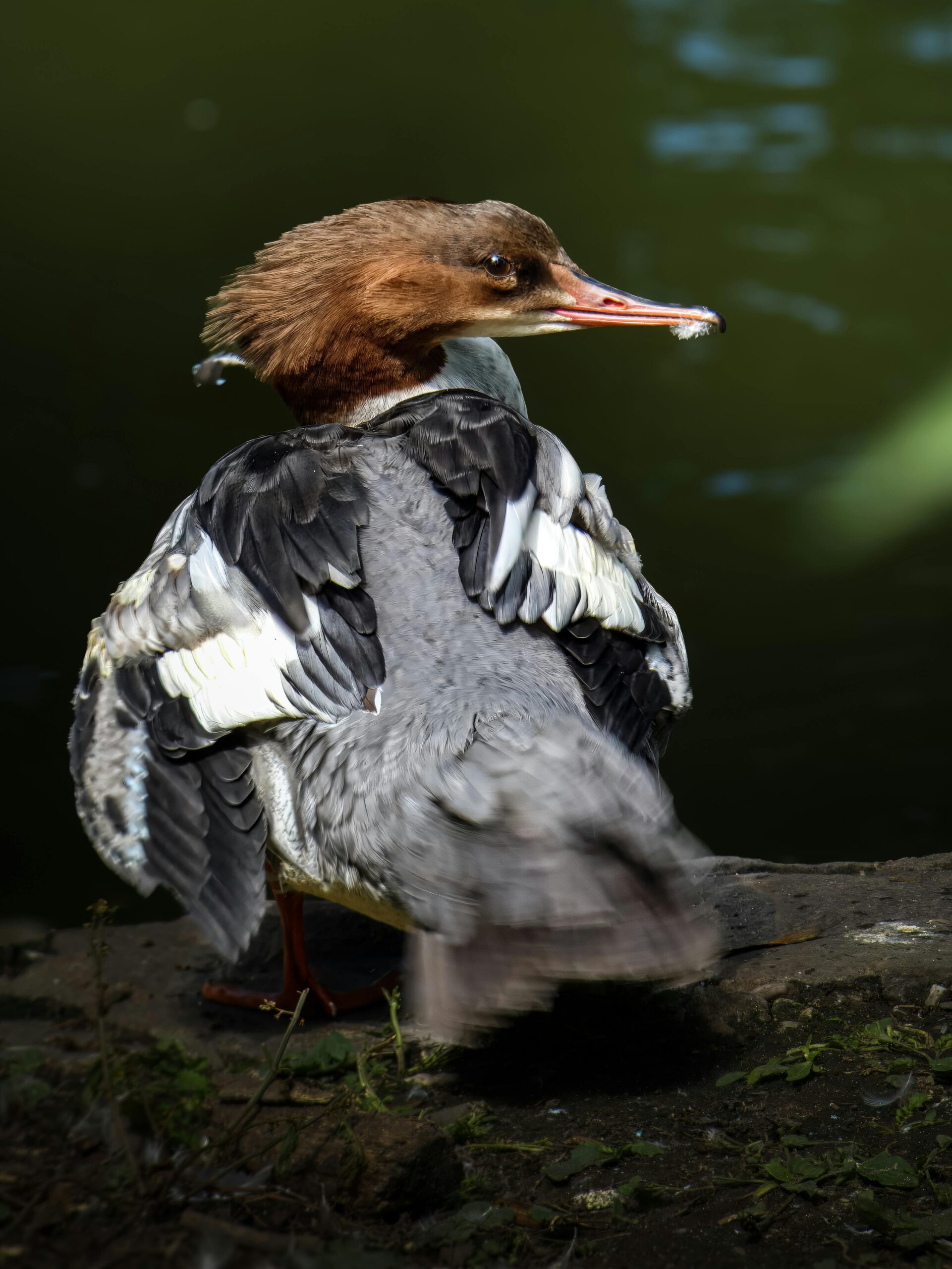
Gray body, rusty‑brown head with a ragged crest
Sharp white chin patch
Clean border between head and breast

Size
Length: 58–72 cm (23–28 in),
Wingspan: 78–97 cm (31–38 in),
Weight: 0.9–2.1 kg (2–4.6 lb)
Diet/Foraging
Primarily fish, which they catch by diving and pursuing underwater. Also eat worms, frogs, and occasionally small birds. Can stay submerged for up to two minutes, though most dives are shorter.
Breeding & Nesting
Cavity nesters: use natural tree holes or old woodpecker cavities; Will also use nest boxes. Females may lay eggs in other ducks’ nests (brood parasitism). Ducklings leap from the nest one day after hatching.
Migration
The Common Merganser is a partial migrant, with movements driven mainly by freezing conditions on northern lakes and rivers. Birds that breed in Canada, Alaska, the northern U.S., and northern Eurasia migrate south in autumn to find open water, wintering on large rivers, reservoirs, and coastal bays farther south. Populations in milder regions remain year‑round residents, shifting only short distances if local waters freeze. Overall, their migration is flexible and weather‑dependent, centered on staying near open water where they can continue diving for fish.
Behavior
Powerful diving hunter: Pursues fish underwater using strong legs and serrated bills for gripping slippery prey.
Social in winter: Forms loose flocks on large lakes, rivers, and coastal waters outside the breeding season.
Territorial during breeding: Pairs defend nesting areas near forested rivers and lakes, with females leading ducklings to feeding sites soon after hatching.
