Overview
The Common Eider (Somateria mollissima) is one of the North’s most iconic sea ducks—big, social, beautifully patterned, and deeply tied to coastal ecosystems and human culture. Here’s a complete, structured profile grounded in the latest information.
A large, heavy-bodied sea duck found across the northern coasts of Europe, North America, and eastern Siberia. It breeds in Arctic and subarctic regions and winters slightly farther south on cold coastal waters.
Distribution & Habitat
Breeding: Arctic islands, tundra coasts, rocky shorelines
Wintering: Cold coastal waters just south of breeding range
Often forms huge flocks—sometimes thousands—offshoreIdentification

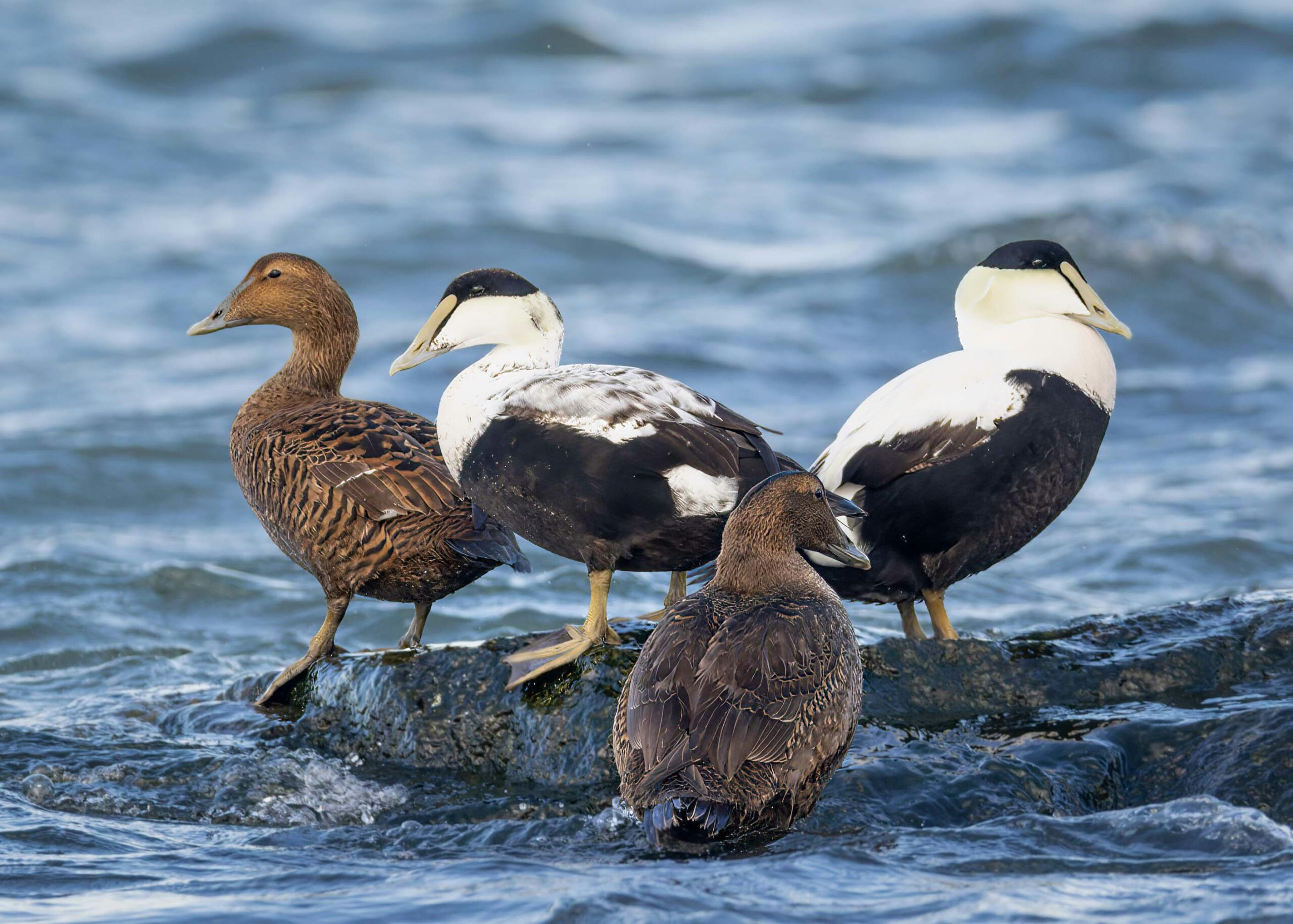
Adult Male
Mostly white body with a green‑black head
Black back, white inner wings
Long, narrow red bill
Sleek, powerful profile
Adult Female
Gray body, rusty‑brown head with a ragged crest
Sharp white chin patch
Clean border between head and breast

Size
Length: 58–72 cm (23–28 in),
Wingspan: 78–97 cm (31–38 in),
Weight: 0.9–2.1 kg (2–4.6 lb)
Diet/Foraging
Primarily marine invertebrates. Specializes in mollusks (especially mussels), and dives to the seafloor, sometimes in strong currents
Breeding & Nesting
Nests on coastal islands, often in dense colonies. Female lines the nest with eiderdown plucked from her breastChicks leave the nest within 24 hours and feed themselvesFemales often form crèches—groups of many ducklings guarded by multiple females.
Migration
The Common Eider is a mostly coastal migrant, with birds from the high Arctic and subarctic moving south each fall to reach ice‑free wintering waters, while more southern populations migrate only short distances or remain resident. Northern breeders leave as sea ice forms, traveling along coastlines to wintering areas in places like Atlantic Canada, New England, the North Sea, and northern Europe. In spring, they return to their breeding grounds—often in large, synchronized movements—to nest on Arctic islands, rocky coasts, and tundra shorelines. Migration distances vary widely by region, but overall the species follows a predictable pattern of shifting between northern breeding sites and more temperate coastal waters where food remains accessible through winter.
Behavior
Coastal specialist: Spends nearly all its life in marine environments, diving for mollusks and crustaceans in shallow coastal waters.
Highly social: Forms large flocks outside the breeding season, especially during winter and molting periods.
Protective and coordinated: Females often cooperate in raising ducklings, forming crèches where multiple hens guard and guide young together.
