Overview
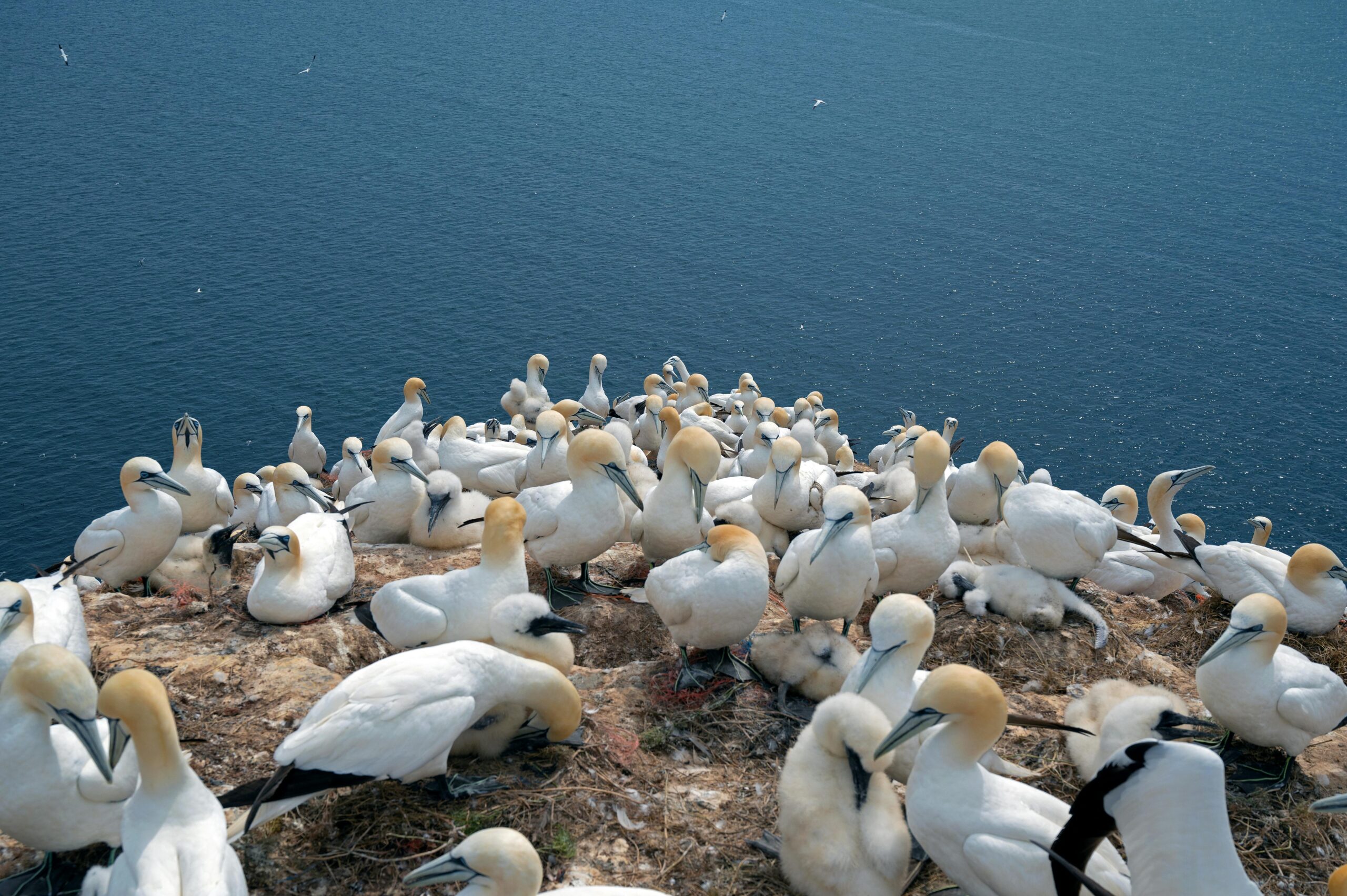
Gannets are large, powerful seabirds built for life over the open ocean, instantly recognizable by their white bodies, black wingtips, and softly golden heads. They spend most of their lives far offshore, returning to land only to breed in huge, noisy cliffside colonies. Their signature behavior is high‑speed plunge‑diving—they spot fish from the air, fold their wings, and hit the water at remarkable speed before chasing prey underwater with their wings. Northern Gannets migrate widely across the North Atlantic, while other species make shorter coastal movements. Altogether, gannets are among the most dramatic and specialized seabirds on the planet, perfectly adapted to long‑distance flight and precision hunting at sea.
Distribution & Habitat
Different species occupy temperate and subtropical oceans:
- Northern Gannet: North Atlantic—breeds on cliffs and islands from Canada and Iceland to the British Isles and Norway.
- Cape Gannet: Southern Africa.
- Australasian Gannet: Coasts of Australia and New Zealand.
They spend most of their lives far offshore, returning to land only to breed.

Adult Male
Mostly white plumage with clean, bright body and wings
Black wingtips forming a sharp contrast in flight
Soft golden or buff‑yellow head and nape, strongest in breeding season
Long, pointed pale‑blue or gray bill with dark lines along the face
Blue‑ringed eyes giving a striking facial look
Long, tapered tail and narrow, pointed wings built for diving
Large size, with a wingspan up to about 2 meters
Adult Female
Mostly white plumage, same as the male
Black wingtips with sharp contrast in flight
Soft golden or buff‑yellow head and nape, often slightly paler than males
Long, pointed pale‑blue or gray bill with dark facial lines
Blue‑ringed eyes
Long, tapered tail and narrow, pointed wings

Size
Length: 87–100 cm (34–39 in)
Wingspan: 165–180 cm (65–71 in),
Weight: 2.3–3.6 kg (5–8 lb), with males and females very similar
Diet/Foraging
Gannets eat mainly schooling fish like herring and mackerel, plus some squid. They hunt by high‑speed plunge‑diving, hitting the water at extreme speed and then chasing prey underwater with their wings. Their dive height, depth, and style shift depending on the prey they’re targeting.
Breeding & Nesting
Gannets are colonial nesters, gathering in huge, noisy cliffside colonies. They typically lay one egg, incubated using their webbed feet rather than brood patches. They reach maturity at about five years.
Migration
Northern Gannets migrate the most: after breeding, they leave North Atlantic colonies and move south along the coasts, reaching the southeastern US, Gulf of Mexico, West Africa, and sometimes farther. Cape and Australasian Gannets are mostly local migrants or dispersers, shifting along coastlines rather than traveling long distances. All gannets spend the non‑breeding season entirely at sea, roaming widely over productive ocean waters.
Behavior
Spectacular plunge‑diving hunters: They dive from high in the air at extreme speed, then chase fish underwater using their wings.
Strongly colonial: They breed in dense, noisy cliffside colonies, showing synchronized displays and tight social structure.
Wide‑ranging at sea: Outside the breeding season they roam far offshore, covering huge distances while foraging over open ocean.
