Overview
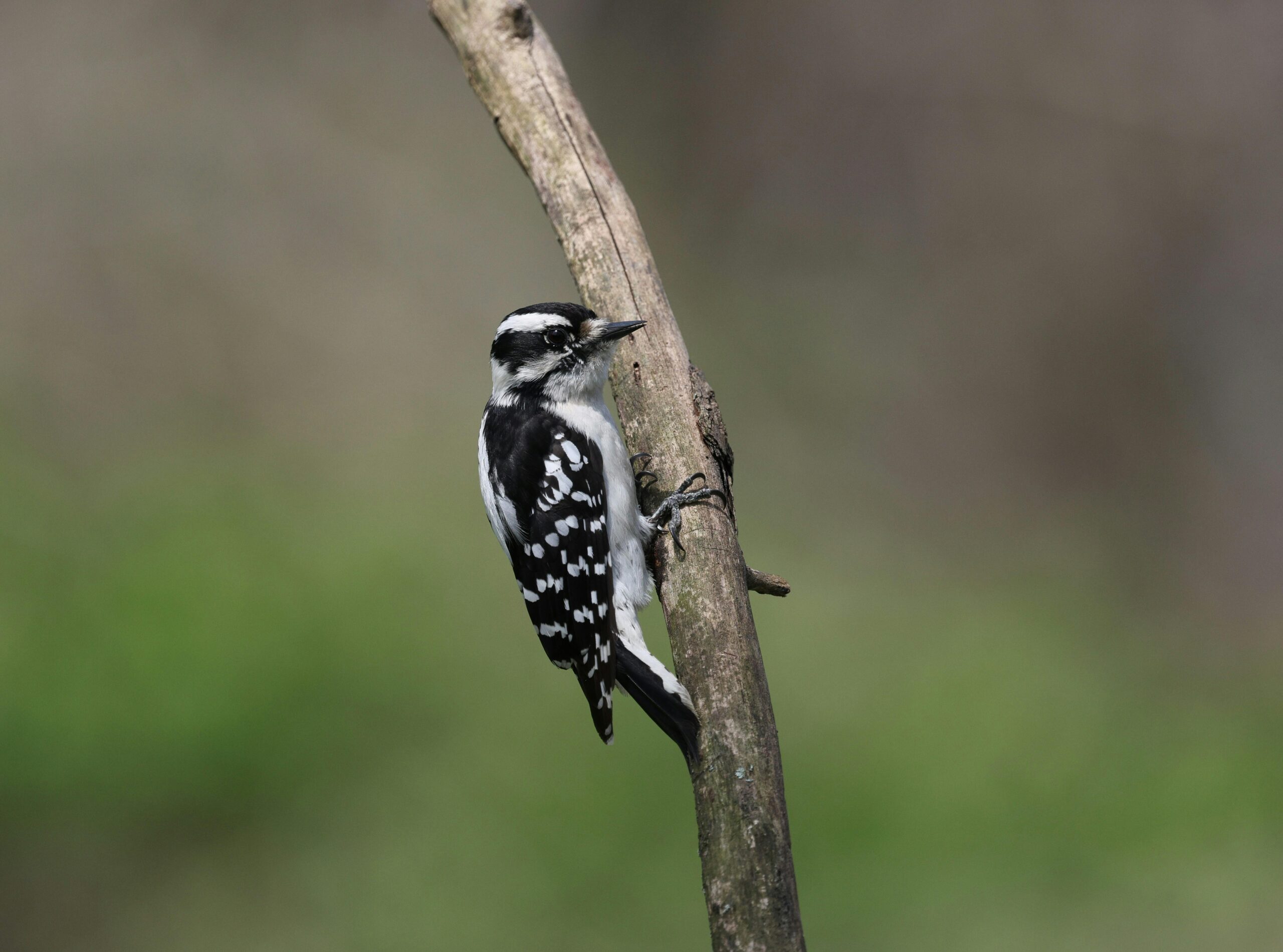
The Downy Woodpecker is the smallest and one of the most widespread woodpeckers in North America, easily recognized by its black‑and‑white plumage, short bill, and the male’s small red nape patch. It lives in forests, parks, orchards, and suburban yards, where it forages acrobatically on small branches, stems, and even weed stalks for insects, seeds, and suet from feeders. Its sharp “pik” call, whinnying rattle, and rapid drumming make it a familiar sound in woodlands. Downies excavate their own nest cavities each spring, raising 4–5 young and often reusing the same territory year after year. They remain in their range throughout all seasons, adapting well to winter by joining mixed flocks with chickadees and nuthatches.
Distribution & Habitat
Downy Woodpeckers are common across nearly all of the United States and Canada, except the arid Southwest and far northern tundra. They inhabit deciduous forests, woodlots, orchards, river groves, and suburban neighborhoods, frequently visiting backyard feeders. Their adaptability allows them to thrive in both wilderness and urban environments.

Adult Male
Small red patch on the back of the head (the key male marker)
Black‑and‑white striped head with a white stripe down the center
White belly and breast with clean, smooth plumage
Black wings with white spots, giving a checkered look
Short, stubby bill—about half the length of the head
White back patch between the wings
Black tail with white outer feathers that show small black spots
Adult Female
No red patch on the head (the key difference from the male)
Black‑and‑white striped head with a clean white center stripe
White underparts with smooth, soft plumage
Black wings with white spots, creating a checkered pattern
Short, stubby bill about half the length of the head
White back patch between the wings
Black tail with white outer feathers

Size
Length: 14–18 cm (5.5–7.1 in)
Wingspan: 25–30 cm (9.8–11.8 in)
Weight: 20–33 g, with males and females overlapping in size
Diet/Foraging
Their diet is primarily insects, especially beetle larvae, ants, and caterpillars. They also eat seeds, berries, and occasionally tree sap. At feeders, they readily take suet, sunflower seeds, peanuts, and even visit hummingbird or oriole feeders for sugar water. Their ability to exploit small branches and weed stems allows them to access food larger woodpeckers cannot.
Breeding & Nesting
Downy Woodpeckers excavate a fresh nest cavity each spring in dead or soft wood, where the female lays 4–5 white eggs. Both parents incubate for about 12 days, with the male taking the night shift. The chicks stay in the cavity for 20–25 days, fed entirely on insects brought by both adults. After fledging, the young remain nearby briefly before becoming independent.
Migration
Downy Woodpeckers are non‑migratory. They stay in their home range all year, even through winter. Birds in the far north or at higher elevations may shift short distances to lower, more sheltered areas when temperatures drop, but they don’t make true long‑distance migrations.
Behavior
Active, acrobatic forager: Moves along small branches, stems, and even weed stalks, tapping and probing for insects other woodpeckers can’t reach.
Drumming and vocal communication: Uses rapid drumming and sharp “pik” calls to signal territory and stay in contact with mates or flock members.
Joins mixed winter flocks: Frequently travels with chickadees and nuthatches in winter, gaining better protection and foraging efficiency.
