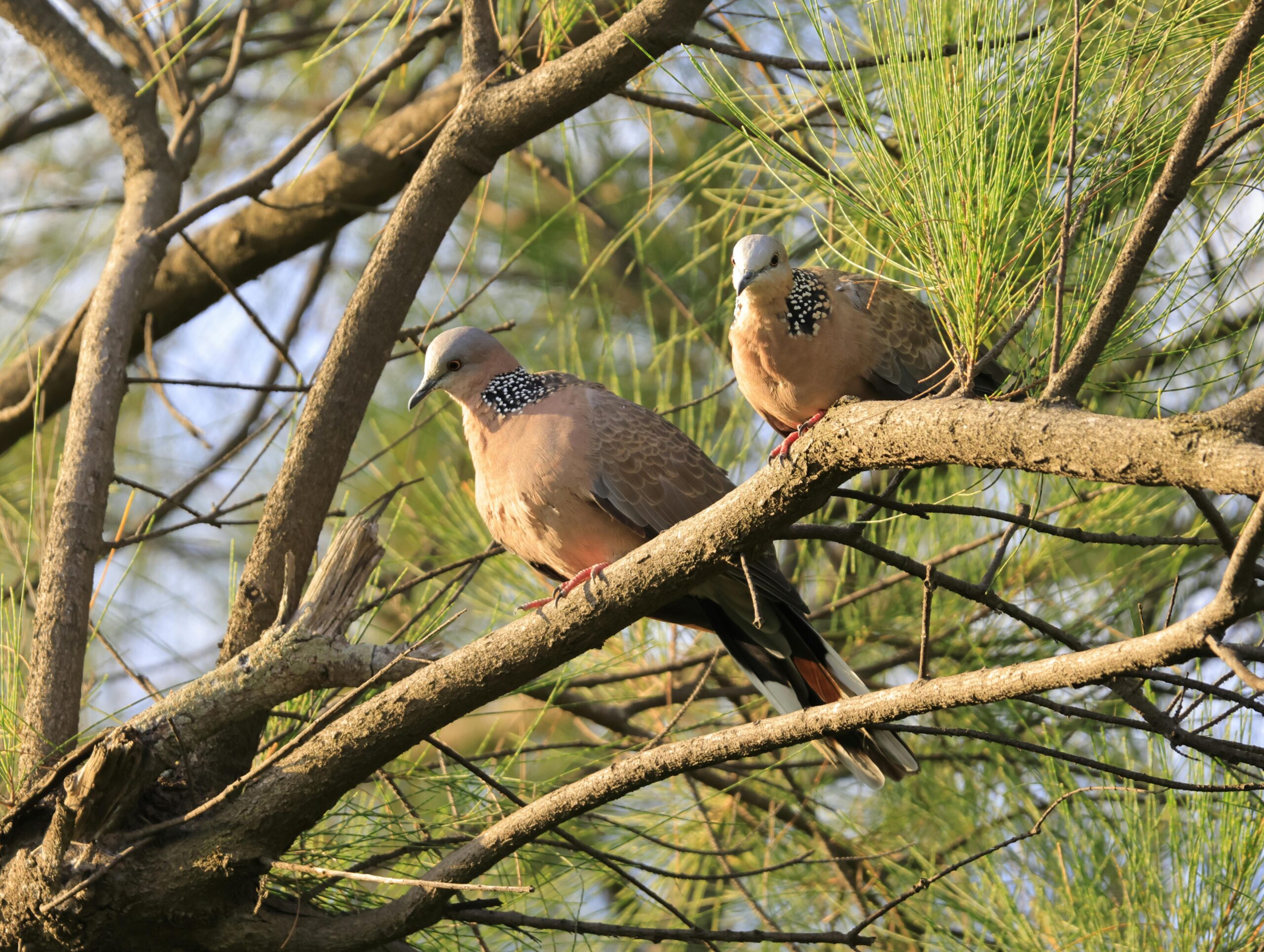
Overview
The Spotted Dove (Spilopelia chinensis) is a large, slender dove with mauve‑pink underparts, a grayish head, and its signature feature—a broad black collar with fine white spots on the back and sides of the neck. This “spotted” patch is the key field mark across its range. The bird has a long, rounded tail with white tips that show in flight.
Distribution & Habitat
The species is native to southern and eastern Asia, including India, Sri Lanka, China, Southeast Asia, and surrounding regions. It has also been introduced widely, with established populations in Hawaii, Southern California, Australia, New Zealand, and parts of Oceania.
Spotted Doves thrive in towns, gardens, farmland, open woodlands, and suburban areas. They are especially common near human habitation, often seen walking on lawns, roadsides, and parks. They prefer well‑watered areas with trees, but adapt easily to urban environments.

Adult Male
Black collar with white spots on the sides/back of the neck
Pinkish‑brown body with a soft mauve wash
Grayish head with a clean, smooth look
Long tail with white tips visible in flight
Slightly glossier neck feathers than females, but sexes look very similar
Adult Female
Black‑and‑white spotted neck patch, same as the male
Brownish‑pink body with a softer, duller tone than males
Grayish head with a slightly less crisp contrast
Long tail with white tips, visible in flight
Overall less glossy plumage, giving a more muted look

Size
Length: ~13 in (33 cm)
Weight: 5.1–6 oz (144–170 g)
Wingspan: Not well‑documented in North American sources
Diet/Foraging
Their diet is mostly seeds, which they pick from the ground while walking in a calm, deliberate manner. They often forage in pairs or small groups and will feed beneath bird feeders to collect fallen seed. In autumn, they especially love acorns.
Breeding & Nesting
Spotted Doves typically nest in trees or shrubs, building a simple platform nest. They usually lay two white eggs, and both parents participate in incubation and feeding the young with pigeon milk—a nutrient‑rich secretion produced in the crop.
Migration
Spotted Doves are sedentary birds, meaning they remain in their home range throughout the year. They do not migrate because their habitats—urban areas, farmland, gardens, and open woodlands—provide stable food sources (mainly seeds) in all seasons. Instead of migrating, they may make short local movements to find food, water, or nesting sites, but these shifts are small and not considered true migration.
Behavior
Calm ground‑forager — walks slowly while picking seeds from the ground, often in pairs or small groups.
Tame and approachable — comfortable around humans and common in gardens, parks, and urban areas.
Explosive takeoff — when startled, bursts into flight with loud wing‑flaps as an alarm response.
