Overview
The Green Woodpecker (Picus viridis) is a large, ground‑feeding European woodpecker known for its green plumage, red crown, yellow rump, and loud “laughing” call.
The Green Woodpecker is one of Europe’s most recognizable woodpeckers, famous for its bright green upperparts, yellow rump, and distinctive laughing call often described as “yaffling.” Unlike many woodpeckers, it spends much of its time on the ground, feeding mainly on ants. It is widespread across most of Europe and western Asia, favoring areas where woodland meets open ground.
Distribution & Habitat
Green Woodpeckers occur across most of Europe, extending into western Asia. They prefer:
- Deciduous or mixed woodland
- Parks and gardens
- Grasslands and orchards They require trees for nesting but open ground for feeding, especially lawns and meadows rich in ant colonies.

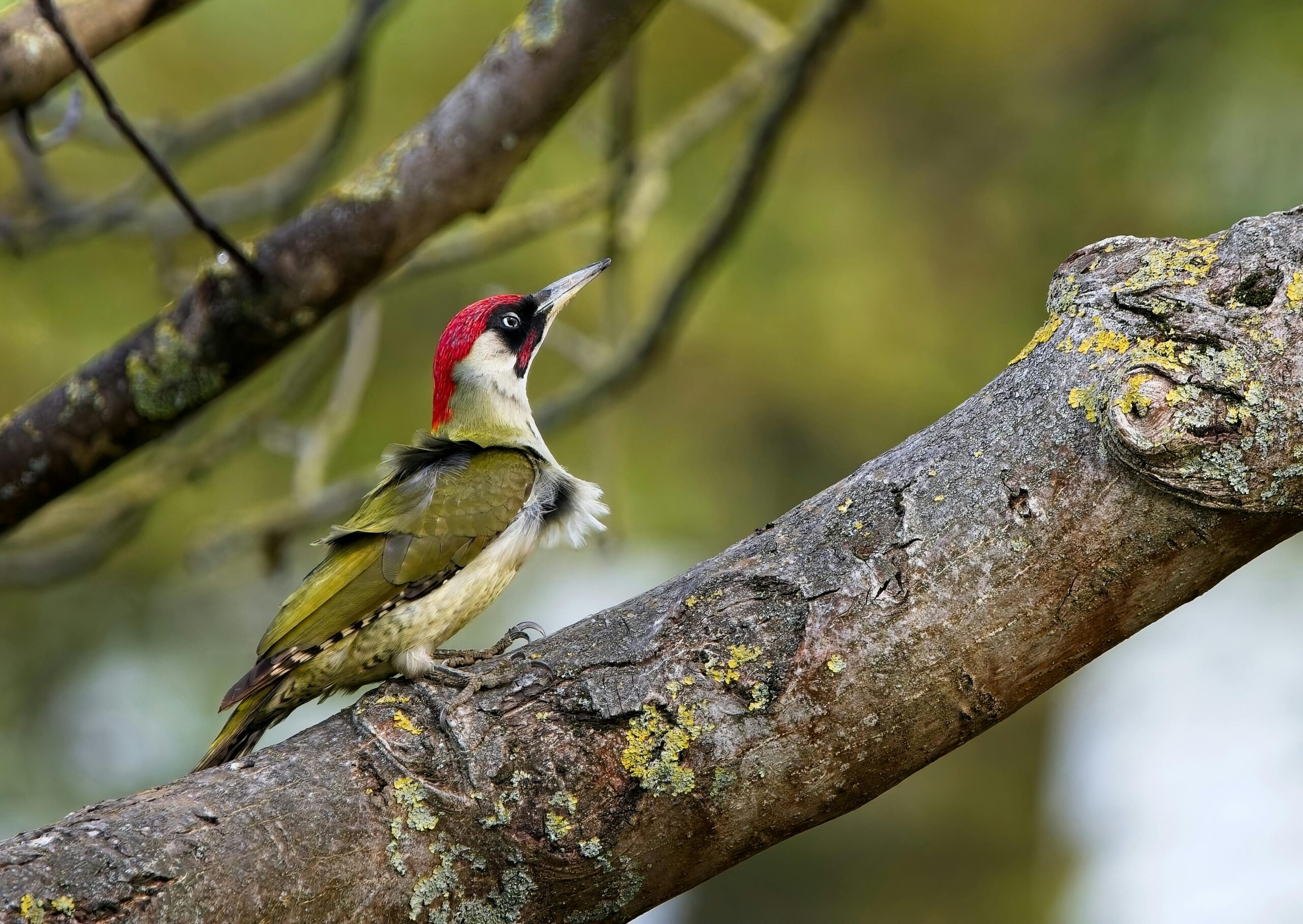
Adult Male
Red crown on top of the head, a key feature of the species.
Black moustache stripe with a red center — the only reliable sex‑specific marker distinguishing males from females.
Green upperparts, giving the bird its name.
Paler belly with grey‑green tones.
Bright yellow rump, very noticeable in flight.
Strong, elongated bill, typical of woodpeckers.
Dark green wings visible during flight.
Adult Female
Red crown on top of the head, just like the male
Black moustache stripe without any red — the key feature that separates females from males
Green upperparts with a slightly duller tone than the male at times
Grey‑green underparts, paler than the back
Bright yellow rump, very visible in flight

Size
Length: 30–36 cm (12–14 in)
Wingspan: 40–50 cm (16–20 in)
Weight:
Diet/Foraging
Their diet is dominated by ants, which they extract using their long, sticky tongue—so long it coils behind the skull when retracted. They also take other insects and occasionally small reptiles. They forage mostly on the ground, a behavior unusual among woodpeckers.
Breeding & Nesting
Nests are excavated in soft or decaying wood by both sexes.
Clutch: 4–6 eggs.
Incubation: ~19–20 days by both parents.
Fledging: 21–24 days after hatching.
Migration
Green Woodpeckers are mostly non‑migratory. They stay in the same general area year‑round across Europe. Instead of long migrations, they make short local movements when winter weather becomes severe, especially if snow or frozen ground makes it hard to reach ant nests—their main food source. Even then, they rarely travel far and remain within their home region.
Behavior
Loud, laughing call (“yaffle”), often heard before the bird is seen.
Rarely drums, unlike most woodpeckers.
Shy and wary, often flying off with a flashing yellow rump.
