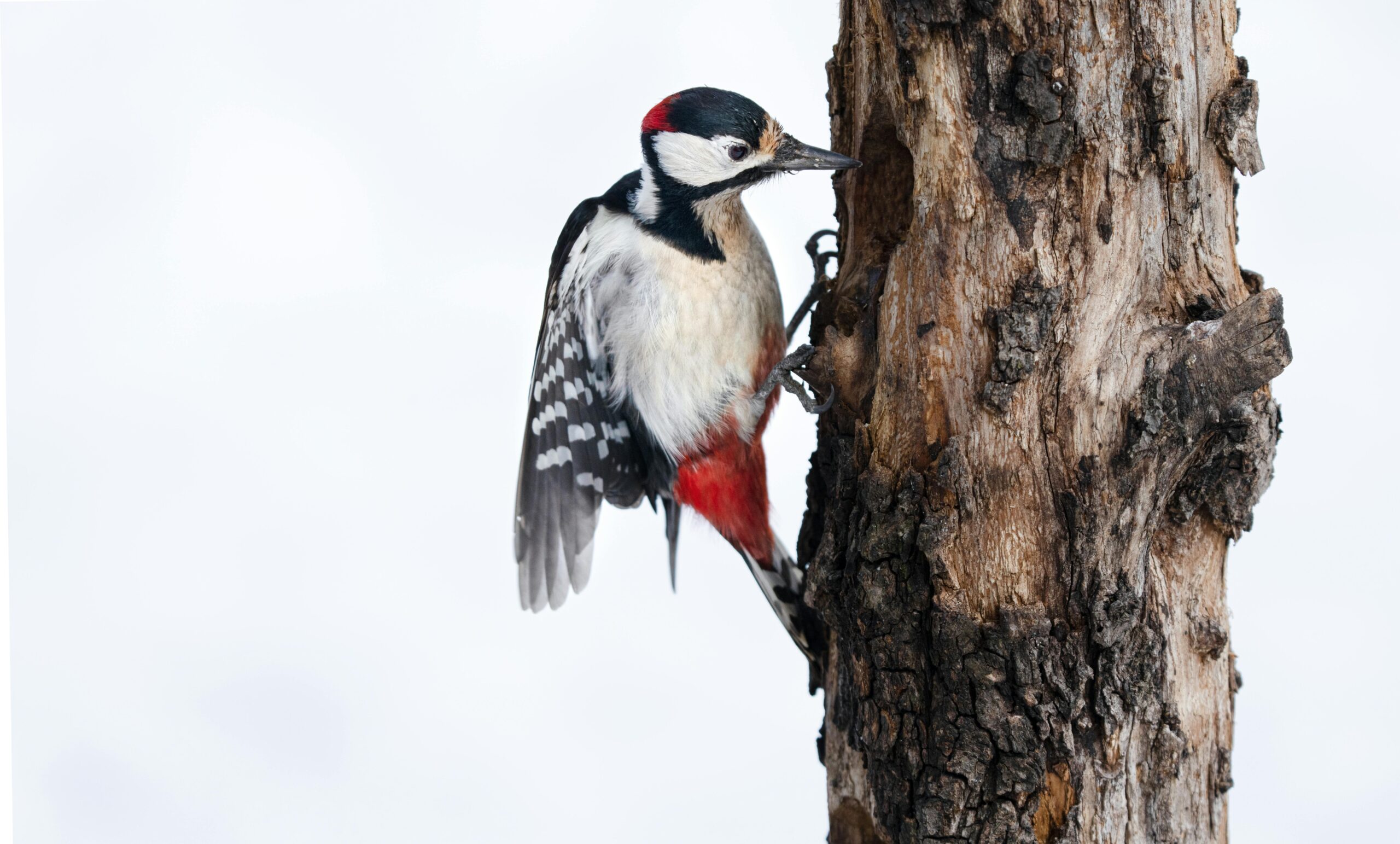
Woodpeckers belong to the family Picidae, which includes true woodpeckers, piculets, wrynecks, and sapsuckers. Globally, there are about 240 species in this family, though Britannica lists about 180 true woodpecker species in the subfamily Picinae. They are found almost everywhere except Australia, New Guinea, New Zealand, Madagascar, and the polar regions.
Most woodpeckers live in forests, woodlands, and shrublands, though some adapt to deserts, rocky hillsides, or even cacti (like the Gila woodpecker). North America alone hosts 22 species, including Downy, Hairy, Red‑bellied, and Pileated woodpeckers.
Woodpeckers peck for two main reasons:
- Foraging — drilling into bark to reach insects and larvae.
- Communication — “drumming” on wood or metal to attract mates or mark territory. Their pecking can reach 20 strikes per second, powered by strong neck muscles and a skull structure that protects the brain.
Most woodpeckers are solitary or travel in pairs. An exception is the Acorn Woodpecker, which has a complex cooperative social system.
Several remarkable features help woodpeckers survive their high‑impact lifestyle:
- Stiff tail feathers used as a prop while climbing tree trunks. (Supported by general anatomical descriptions.)
- Shock‑absorbing skull supported by a specialized hyoid bone that wraps around the skull.
- Long, extendable tongues that reach deep into crevices for insects.
Why they are Important:
- Create nesting cavities for other animals — Up to 27 vertebrate species may use a single woodpecker-made hole, and over 85 species rely on these cavities in some forests.
- Control harmful insects — They eat wood‑boring beetle larvae and other pests, helping prevent infestations and protecting forest health.
- Support nutrient cycling — Their drilling lets air, fungi, and insects into trees, speeding decomposition and enriching soil.
- Increase biodiversity — Because they create most available tree cavities (up to 90% in some forests), they act as keystone species that support many birds and mammals.
- Help maintain ecosystem balance — By providing shelter, controlling pests, and shaping habitats, they keep forests healthier and more resilient.