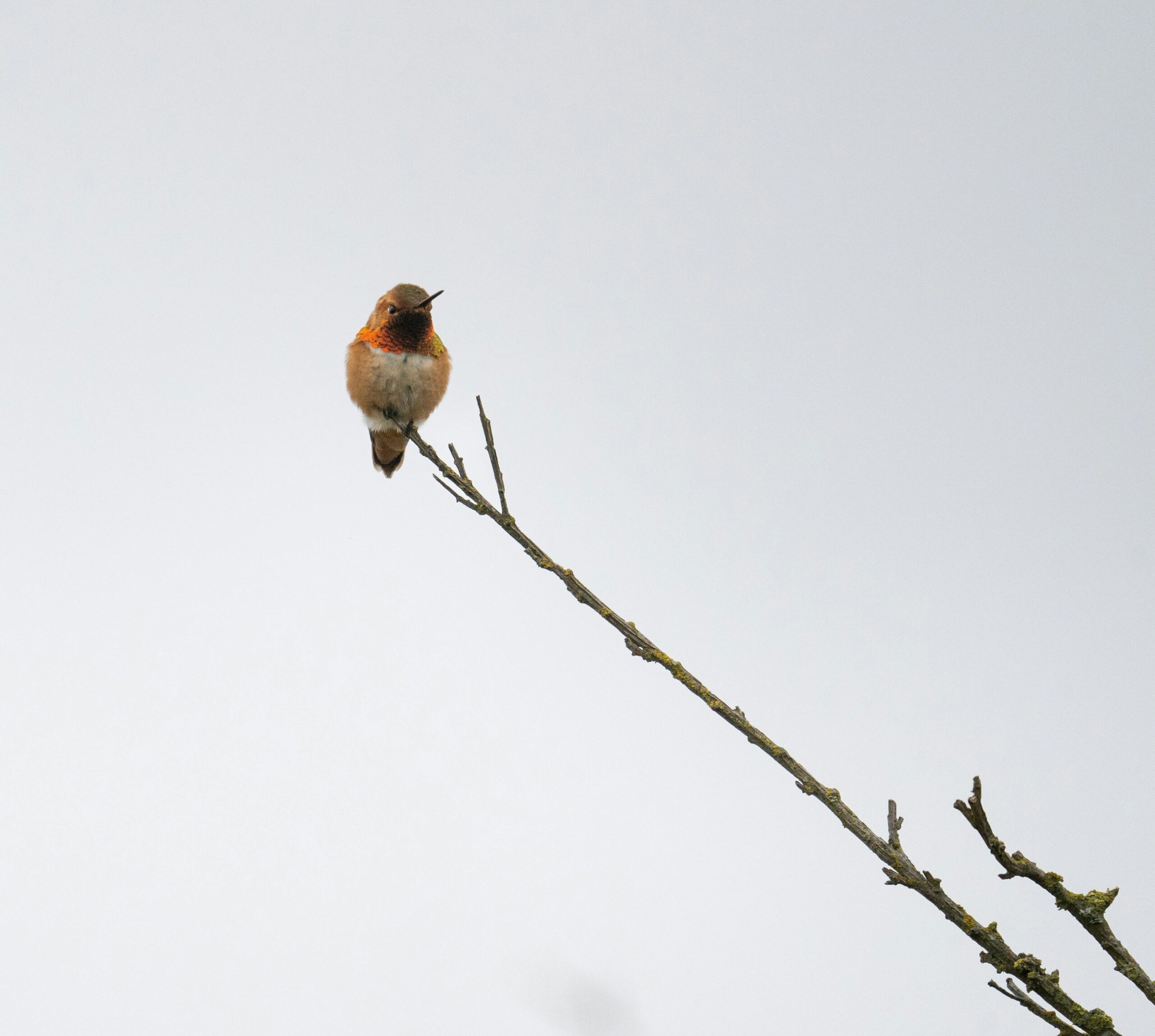
Overview
The Rufous Hummingbird (Selasphorus rufus) is a small hummingbird measuring 7–9 cm (2.8–3.5 in) with a wingspan of about 11 cm (4.3 in) and weighing 2–5 g. Adult males are unmistakable with bright coppery‑rufous bodiesand an iridescent orange‑red throat (gorget). Females are green-backed with rusty flanks, white underparts, and some orange spotting on the throat.
Distribution & Habitat
Rufous Hummingbirds breed from southern Alaska through British Columbia and the Pacific Northwest, favoring forest edges, meadows, streamsides, and mountain clearings. They winter primarily in Mexico, especially pine‑oak woodlands. They are also known for wandering widely, with increasing records in the eastern U.S. during fall and winter.

Adult Male
Bright orange‑rufous body overall
Iridescent orange‑red gorget (throat)
White chest patch below the gorget
Greenish crown/back may be present on some males
Rufous tail with pointed tips
Adult Female
Green upperparts with a coppery wash
White throat with scattered orange spots
Rufous flanks and base of tail
Green crown (unlike the male’s mostly rufous head)
Rufous tail with white tips on the outer feathers

Size
Length: 2.8–3.5 inches (7–9 cm)
Wingspan: 4.3 inches (11 cm)
Weight: 0.1–0.2 oz (2–5 g)
Diet/Foraging
Rufous Hummingbirds feed on flower nectar and a wide variety of small insects (flies, bees, wasps, etc.). They are highly aggressive at feeders and flowers, often chasing away larger hummingbirds. They also steal insects from spider webs and perform rapid aerial maneuvers to catch prey.
Breeding & Nesting
They nest in shrubs or trees, often near forest edges or clearings. Females build the nest and raise the young alone. Breeding occurs across the Pacific Northwest into Alaska, making them the hummingbird that nests farther north than any other.
Migration
Rufous Hummingbirds make an extraordinary long‑distance migration, traveling nearly 4,000 miles between their breeding grounds in the Pacific Northwest/Alaska and their wintering areas in Mexico. In spring they move north along the Pacific Coast, following early blooming flowers and sap flows, with males leading the migration. After breeding, they shift to a different route, heading south through the Rocky Mountains where late‑season wildflowers provide fuel for the journey. This clockwise loop—coastal in spring, inland in fall—helps them track seasonal nectar sources with remarkable precision. Their migration is one of the longest, relative to body size, of any bird on the continent.
Behavior
Highly territorial — fiercely defends flowers and feeders, chasing away even larger hummingbirds.
Agile aerial forager — hovers, darts, and performs rapid maneuvers to feed on nectar and catch tiny insects.
Clockwise migrator — follows a unique loop migration: north along the Pacific Coast in spring, south through the Rockies in fall.
