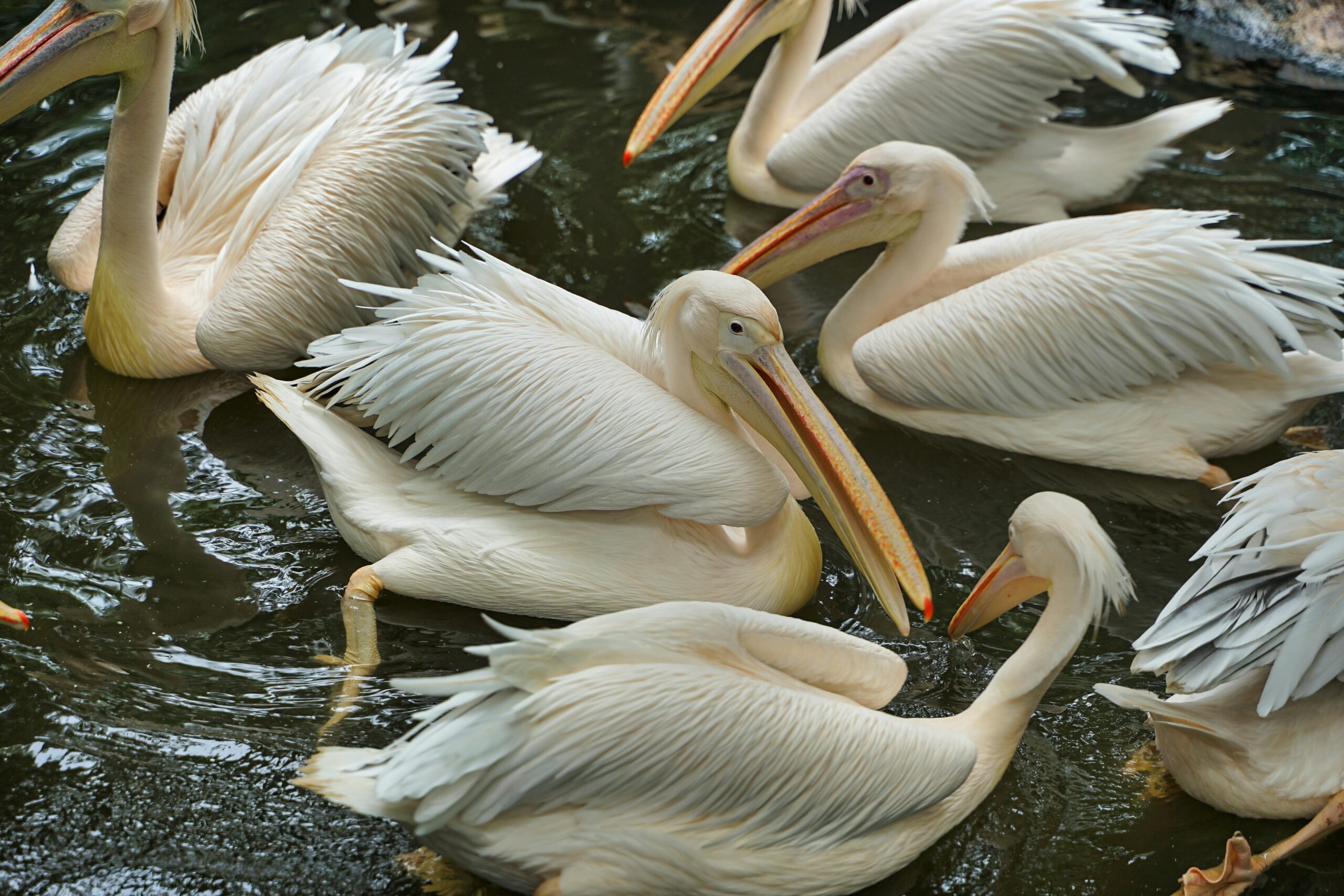
Overview
The Great White Pelican (Pelecanus onocrotalus)—also called the Eastern White Pelican or Rosy Pelican—is one of the largest flying birds in the world, surpassed only by the Dalmatian Pelican among pelicans. It breeds widely from southeastern Europe through Asia and Africa, favoring shallow lakes, marshes, and swamps rich in fish.
This species is classified as Least Concern due to its extremely large range and population size, with no evidence of rapid decline.
Distribution & Habitat
Great White Pelicans inhabit shallow freshwater or brackish wetlands, including lakes, marshes, and river deltas. They occur across Europe, Asia, and Africa, with especially large populations in East Africa.

Adult Male
Mostly white plumage with a soft pink or creamy tint, especially in breeding season
Black flight feathers visible on the wings during flight
Huge yellow bill with a long, expandable pale yellow gular pouch
Pinkish facial skin that becomes brighter in breeding season
Massive body size, slightly larger than the female on average
Short, pale legs (often pinkish)
Slight crest on the back of the head during breeding season
Adult Female
Mostly white plumage with a soft pinkish or creamy tint, similar to the male
Black flight feathers visible clearly when the wings are open
Large yellow bill with a pale yellow to pinkish gular pouch
Facial skin that becomes slightly pinker in breeding season, though usually less vivid than the male’s
Slightly smaller body size compared to the male, though still very large overall
Short, pale legs, often pinkish
Subtle crest on the back of the head during breeding season, usually less pronounced than in males

Size
Length: 140–180 cm (55–71 in)
Wingspan: 226–360 cm (7 ft 5 in to nearly 12 ft), among the widest of any living bird
Weight: 5–15 kg (11–33 lb), with males generally heavier than females
Diet/Foraging
They are piscivores, feeding mainly on fish. Their signature feeding behavior involves cooperative hunting—flocks work together to herd fish into shallow water before scooping them up with their huge pouches.
Breeding & Nesting
Great White Pelicans breed in huge colonies, usually on islands or reed beds near shallow water. They lay 1–3 eggs, incubated by both parents for about a month, using their feet to warm the eggs. Chicks form crèches (nursery groups) once mobile and fledge at around 65–75 days, though they remain dependent for a while afterward.
Migration
Great White Pelicans show mixed migration behavior. Populations in Europe and western Asia are strongly migratory, flying to Africa, India, or the Middle East for winter, often traveling thousands of miles along major river systems and coastlines. African populations are mostly sedentary, moving only locally as water levels change. Their migrations rely heavily on thermal soaring, allowing these massive birds to travel long distances with minimal energy.
Behavior
Cooperative feeding, where groups form semicircles to herd fish into shallow water before scooping them up with their huge pouches.
Highly social living, spending most of their lives in large flocks and nesting in dense colonies that can number thousands.
Efficient soaring flight, using thermals to travel long distances with minimal wing‑flapping despite their massive size.
