Overview
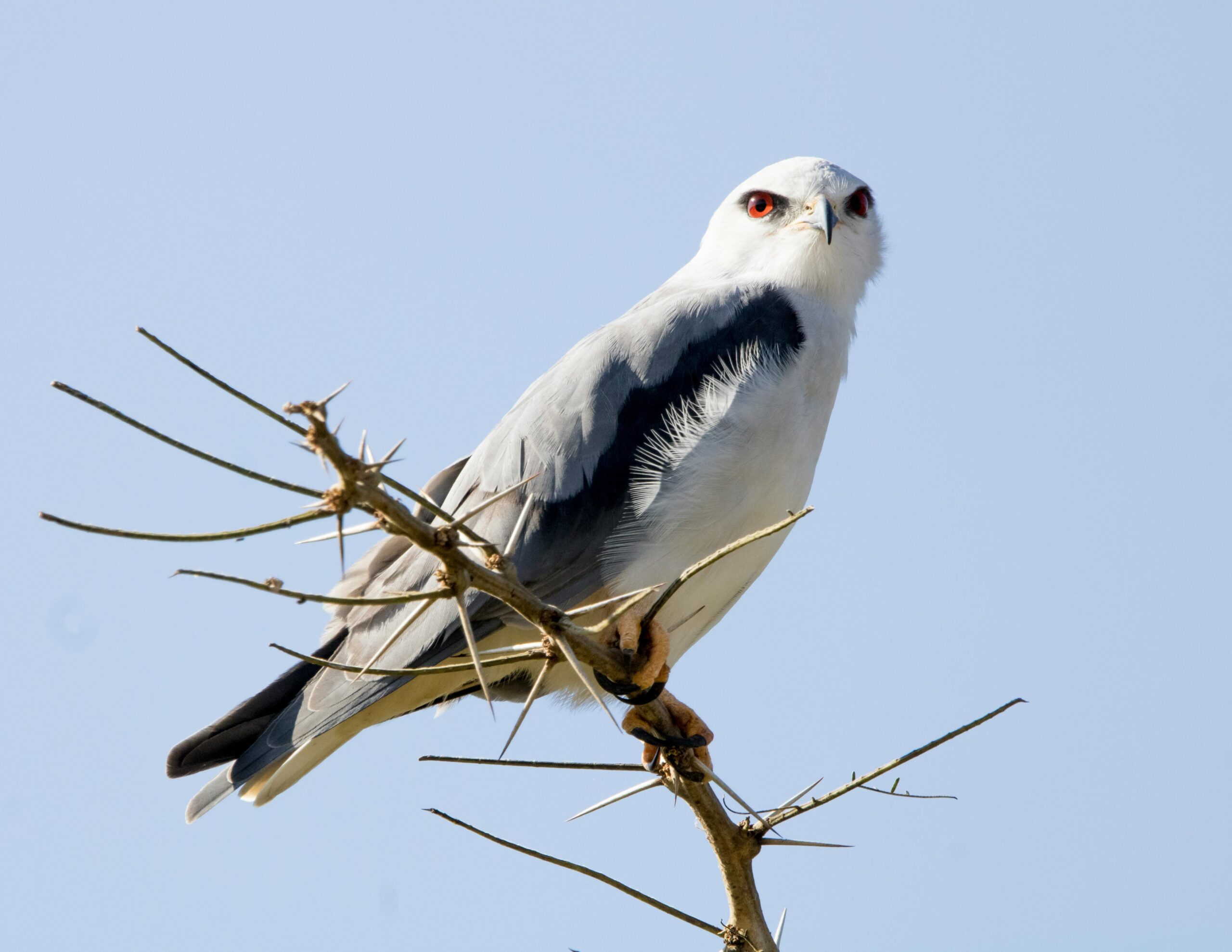
The Letter‑winged Kite (Elanus scriptus)** is a small, irruptive, nocturnal bird of prey found only in Australia. It is the only nocturnal species in the order Accipitriformes, despite having visual anatomy similar to its diurnal relatives.
It is instantly recognizable by the distinct black underwing pattern forming a shallow “M” or “W”, visible in flight and giving the species its name.
The species is currently listed as Near Threatened due to population fluctuations tied to prey availability.
Distribution & Habitat
The Letter‑winged Kite is endemic to arid inland Australia, especially:
- Western Queensland
- Northern South Australia
- Southern Northern Territory
It inhabits open country, grasslands, and arid/semi‑arid regions, often near tree‑lined watercourses. It is irruptive and nomadic, dispersing widely—sometimes to coastal areas—when rodent populations boom.

Adult Male
Pale grey upperparts with a white head and underparts
Bold black “M/W” pattern on the underwings (the key ID feature)
Red eyes with a black eye‑patch
Long, narrow wings built for silent hovering
Black wingtips and black shoulder patches
Small, hooked bill and
Adult Female
White head and underparts with pale grey upperparts
Distinct black “M/W” pattern across the underwings
Red eyes with a black eye‑patch
Long, narrow wings suited for silent hovering
Black shoulder patches and black wingtips
Small hooked bill and

Size
Length: ~35 cm (14 in)
Wingspan: 84–100 cm (33–39 in)
Weight: 260–340 g
Diet/Foraging
The Letter‑winged Kite is a specialist rodent hunter, feeding mainly on Long‑haired Rats, with other small mammals taken when available. Its entire population rises and falls with rodent numbers.
It is a nocturnal forager, hunting at night by hovering silently over open grasslands and arid plains, using its excellent low‑light vision to detect movement. When prey is abundant, it may hunt repeatedly through the night, often delivering food to nestlings in rapid succession. During the day, it typically roosts quietly in trees, becoming active again at dusk.In autumn, they especially love acorns.
Breeding & Nesting
Letter‑winged Kites breed opportunistically, beginning only when rodent numbers—especially Long‑haired Rats—rise sharply. During these boom periods, they often form loose nesting colonies, sometimes with dozens of pairs clustered in the same area.
They build stick nests placed 6–14 meters high in trees, usually along watercourses or in scattered woodland within otherwise open country. Each clutch contains 3–4 eggs, which are incubated for about 30 days.
Migration
Letter‑winged Kites are not true migrants. Instead, they are nomadic, shifting their range within inland Australia depending on rodent abundance, especially Long‑haired Rats. When prey numbers surge, the kites may irrupt into new areas—sometimes far from their usual arid interior range. When prey collapses, they disperse widely and may vanish from regions where they were recently common. This movement is irregular, unpredictable, and entirely tied to food cycles, not seasons. They remain within Australia year‑round and do not undertake long‑distance seasonal migrations like many raptors elsewhere. Their distribution expands and contracts with boom‑and‑bust ecological cycles, making them one of the continent’s most dynamic and elusive birds of prey.
Behavior
Nocturnal rodent hunter Hunts almost entirely at night, silently hovering over open country to catch rats—unique among kites.
Highly nomadic and irruptive Movements are driven by rodent booms and crashes, causing sudden appearances and disappearances across inland Australia.
Colony‑forming during prey surges When rodents are abundant, they gather in loose colonies, nesting and hunting in the same area until food declines.
