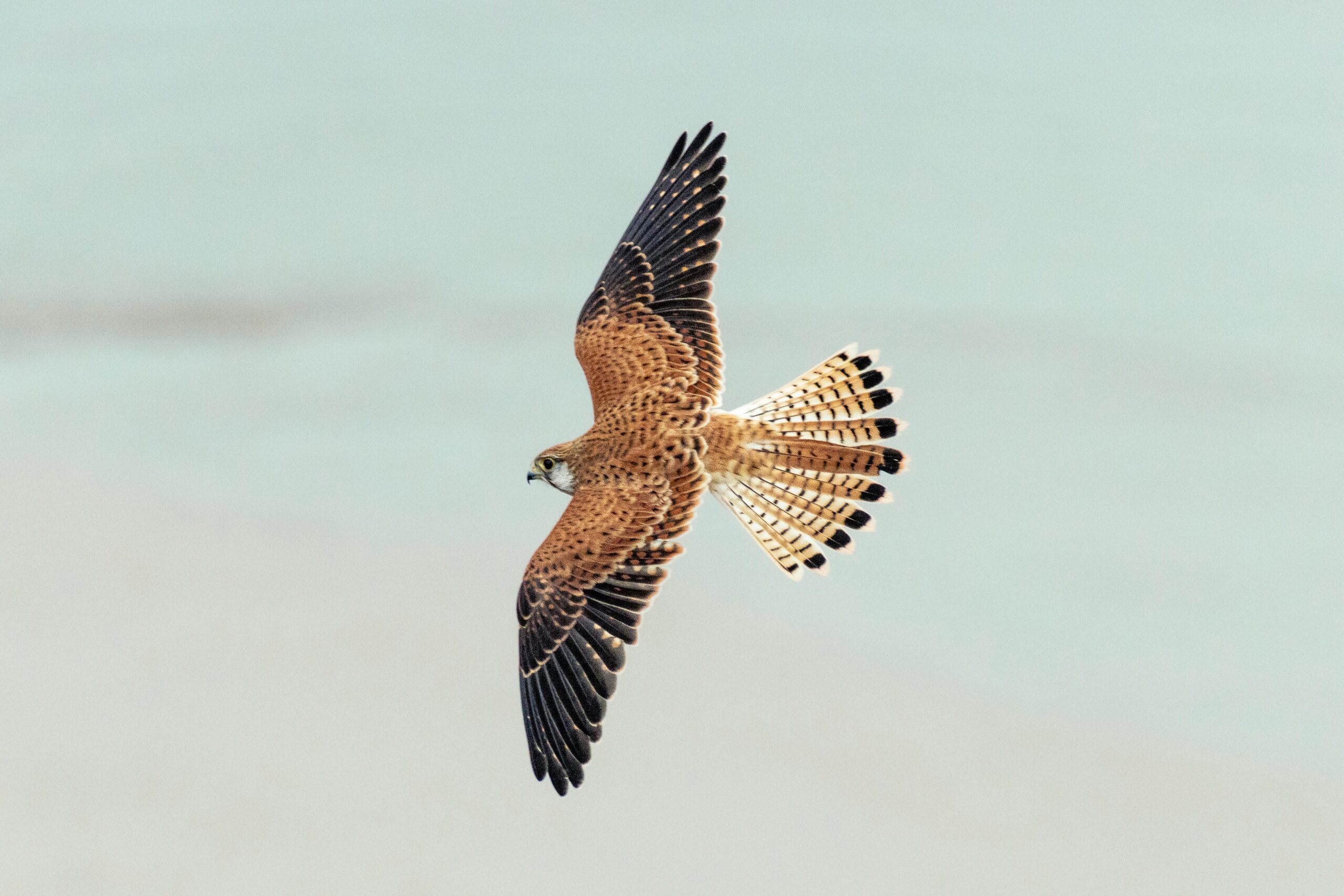
Overview
The Common Kestrel (Falco tinnunculus) is a small, diurnal bird of prey found across Europe, Asia, and Africa, making it one of the most widespread raptors in the Old World. It belongs to the falcon family Falconidae and is often simply called “the kestrel” in regions where it is the only common species. The Common Kestrel is known for its hovering hunting style, warm brown plumage, and adaptability to both open and urban landscapes.
Distribution & Habitat
Common Kestrels occupy a huge native range, occurring throughout Europe, Asia, and Africa, and occasionally appearing as vagrants in North America. They thrive in open habitats such as fields, grasslands, farmland, heaths, and even urban areas, where they perch on posts, buildings, and wires to scan for prey.

Adult Male
Blue‑grey head with a clean, unbarred crown
Chestnut‑brown back and wings marked with small black spots
Blue‑grey tail with a bold black terminal band and thin white edge
Buff underparts with fine dark streaking
Yellow legs and cere, with a dark hooked bill
Distinct black malar stripe
Adult Female
Brown head and nape, lacking the male’s blue‑grey coloration
Warm brown back and wings with heavier black barring rather than spots
Brown, heavily barred tail without the male’s clean blue‑grey and black terminal band
Buff underparts with stronger streaking than the male
Yellow legs and cere, with a dark hooked bill
Distinct black malar stripe, similar to the male

Size
Length: 32–39 cm (12.6–15.4 in)
Wingspan: 65–82 cm (25.6–32.3 in)
Weight: 136–314 g (4.8–11.1 oz)
Diet/Foraging
They feed mainly on small rodents (like voles and mice), large insects, and occasionally small birds or reptiles. Their hunting strategy often involves hovering before diving swiftly onto prey..
Breeding & Nesting
The Common Kestrel breeds in spring, with courtship beginning in late March or April. Pairs do not build their own nests; instead, they use old crow or pigeon nests, cliff ledges, tree cavities, rock crevices, or building ledges, and they readily occupy nest boxes. Females lay 3–7 eggs, usually one every two days. The female handles nearly all incubationfor about 27–31 days, while the male supplies food. After hatching, both parents feed the chicks, which fledge at around 4–5 weeks but remain dependent on adults for several more weeks as they learn to hunt.
Migration
The Common Kestrel is a partial migrant: birds from northern Europe and Asia move south in autumn to escape freezing conditions and declining prey, wintering in milder regions such as the Mediterranean or North Africa. In contrast, kestrels living in warmer climates often stay on their territories year‑round or shift only short distances. Overall, their migration is flexible and driven mainly by the need to maintain access to small mammals and insects through winter.
Behavior
Hover‑hunting specialist: Frequently hovers in place while scanning the ground for small mammals and insects, using sharp vision to detect movement.
Solitary predator: Hunts alone and maintains individual territories, especially during the breeding season.
Adaptable and urban‑tolerant: Readily uses human structures for perching and nesting, thriving in farmland, grasslands, and even cities.
