Overview
The King Vulture (Sarcoramphus papa) is one of the largest New World vultures, found from southern Mexico through Central America to northern Argentina. It inhabits tropical lowland forests, often in remote, undisturbed areas. It is the only living member of its genus, with fossil relatives known from the past.
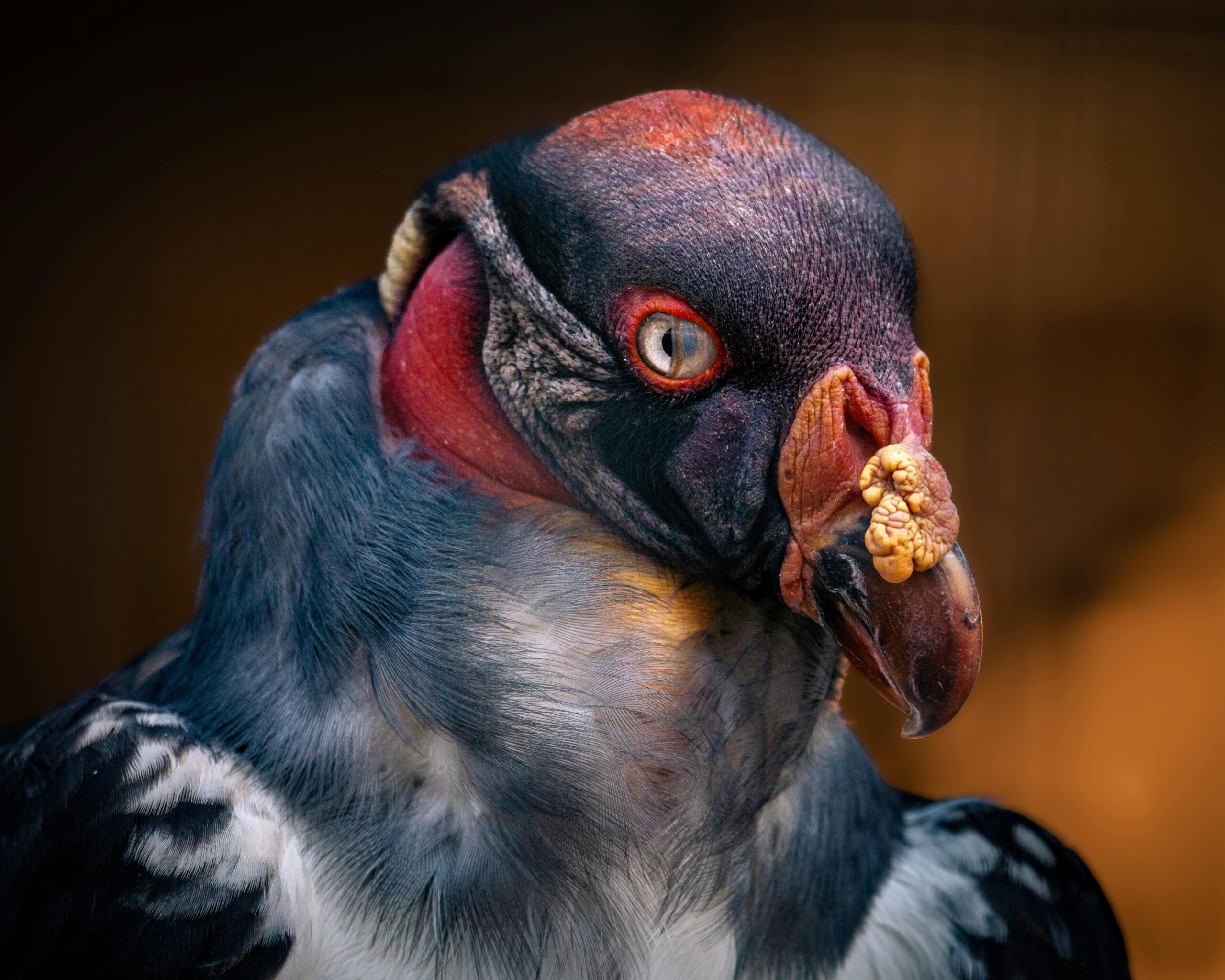
This species is famous for its powerful bill, broad wings, and brightly colored head and neck, which display shades of yellow, orange, red, blue, and purple. It is currently listed as Least Concern, though populations are declining due to habitat loss.
Distribution & Habitat
King Vultures live from southern Mexico to northern Argentina, mainly in tropical lowland forests. They prefer dense, undisturbed rainforest, but also use nearby swamps, savannas, and forest edges. They are mostly found at low elevations, though they can reach foothills in some regions.

Adult Male
White body with black wings and tail
Bare multicolored head (orange, yellow, red, blue, purple)
Large orange caruncle on the bill
Thick orange bill with a hooked tip
Grey‑black neck ruff
White eyes with a red eye‑ring
Pink‑orange legs
Adult Female
White body with black wings and tail
Bare multicolored head (orange, yellow, red, blue, purple)
Large orange caruncle on the bill
Thick orange hooked bill
Grey‑black neck ruff
White eyes with a red eye‑ring
Pink‑orange legs

Size
Length: 67–81 cm (26–32 in)
Wingspan: 1.2–2 m (3.9–6.6 ft)
Weight: 2.7–4.5 kg (6–10 lb)
Diet/Foraging
King Vultures are strict scavengers, feeding almost entirely on carrion from medium‑ to large‑sized animals. They rarely take live prey. Their powerful bill allows them to tear open thick hides that smaller vultures cannot, so they are often first to feed and may dominate other species at carcasses.
They locate food by soaring high on thermals, using excellent eyesight and by watching the behavior of other vultures. They descend quickly once a carcass is found and feed aggressively, often opening the carcass so smaller vultures can access it afterward.
Breeding & Nesting
King Vultures breed once every two years, because raising a chick takes many months. They do not build a nest; instead, they lay a single egg on bare ground inside a tree cavity, hollow stump, cave, or sheltered crevice. Both parents share incubation for 53–58 days.
After hatching, the chick remains in the nest for roughly 130 days, one of the longest nest periods among New World vultures. Parents feed the chick by regurgitation, and care continues well after fledging.
Migration
King Vultures are non‑migratory; they remain in the same region year‑round and do not undertake seasonal migrations. They live in consistently warm climates with stable food availability, so they have no need to travel long distances. This matches general patterns among New World vultures in tropical regions, where most species remain resident unless harsh winters force movement—conditions King Vultures do not experience.
Behavior
Dominant at carcasses King Vultures often arrive early and use their powerful bill to open tough hides, allowing smaller vultures to feed afterward. They frequently displace other scavengers.
Soaring, wide‑ranging flight They spend much of the day circling high on thermals, scanning the forest canopy and clearings for carrion. Their flight is strong, efficient, and mostly silent.
Solitary or small‑group lifestyle They are usually seen alone or in pairs, only gathering in groups at food sources. They are otherwise quiet, calm birds with minimal vocalizations.
