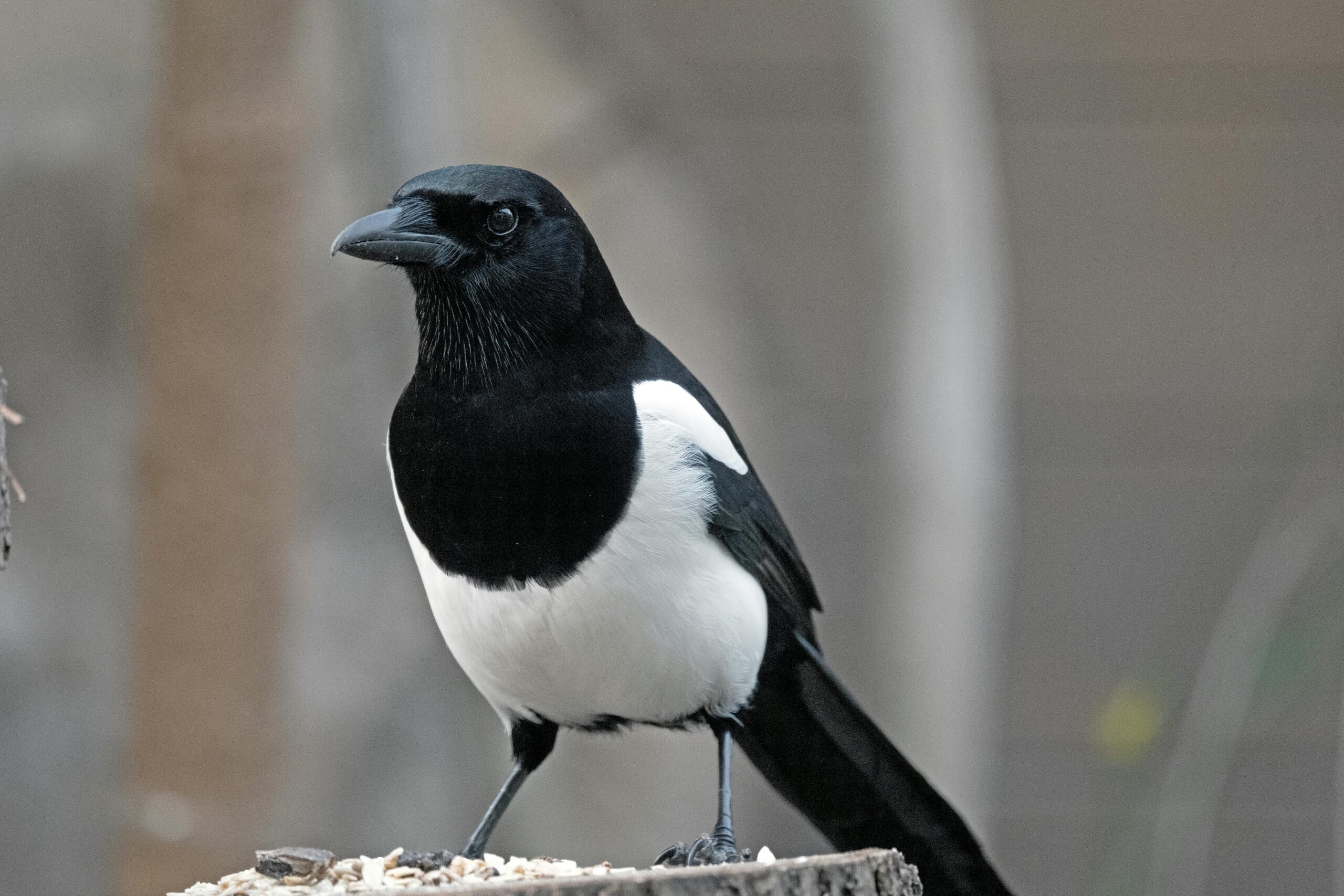
Overview
The Eurasian Magpie (Pica pica) is a resident breeding bird across the northern Eurasian continent, belonging to the crow family (Corvidae). It is widely known for its exceptional intelligence, passing the mirror self‑recognition test, a feat shared with only a few non‑human animals.
The Eurasian Magpie is a highly intelligent black‑and‑white corvid found across Europe and much of Asia, instantly recognizable by its long iridescent tail and bold behavior.
Distribution & Habitat
This species is distributed throughout most of Europe, large parts of Asia, and North Africa, thriving in open woodlands, farmlands, grasslands, parks, and urban areas. Its adaptability allows it to live comfortably near humans, often foraging on lawns or scavenging in towns.

Adult Male
Glossy black head, chest, and back with a green‑purple iridescent sheen
Bright white shoulders and belly, creating a sharp contrast
Long, iridescent tail with blue‑green metallic tones
Black wings with bold white patches visible in flight
Strong black bill and dark eyes
Overall length 44–46 cm, with the tail making up more than half
Adult Female
Same black‑and‑white plumage pattern as the male, with glossy black head, chest, and back
White belly and shoulder patches creating strong contrast
Long iridescent tail, though often slightly shorter on average than the male’s
Black wings with white patches visible in flight
Black bill and dark eyes
Overall size similar to the male,

Size
Length: 44–46 cm (17–18 in), with the tail making up more than half
Wingspan: 52–60 cm (20–24 in)
Weight:
Diet/Foraging
Eurasian Magpies are omnivores, eating insects, small animals, eggs, carrion, seeds, berries, and human scraps. They forage mostly on the ground, walking confidently as they probe soil and vegetation. They also scavenge, cache extra food, and use their intelligence to exploit new or difficult food sources.
Breeding & Nesting
Eurasian Magpies form long‑term pair bonds and begin nesting early in spring. They build large, domed stick nests—often in tall trees or large shrubs—with a mud‑lined cup inside. Both partners help construct the nest, which can take several weeks. The female lays 5–8 eggs and handles most of the incubation, while the male brings food. Chicks hatch after about 3 weeks and remain in the nest for another 3–4 weeks, with both parents feeding them. After fledging, young magpies stay with their parents for several weeks as they learn to forage and navigate social groups.
Migration
Eurasian Magpies are non‑migratory. They stay in their territories year‑round across most of Europe and Asia. In harsher northern regions, some individuals may make short local movements during severe winter weather, but they do not undertake true long‑distance migration.
Behavior
Highly intelligent and social: Lives in complex social groups, solves problems, recognizes individuals, and shows advanced communication.
Bold, opportunistic forager: Walks confidently on the ground, scavenges, caches food, and takes advantage of human environments.
Territorial and vocal: Uses loud chattering calls and tail displays to defend territory and communicate with other magpies.
