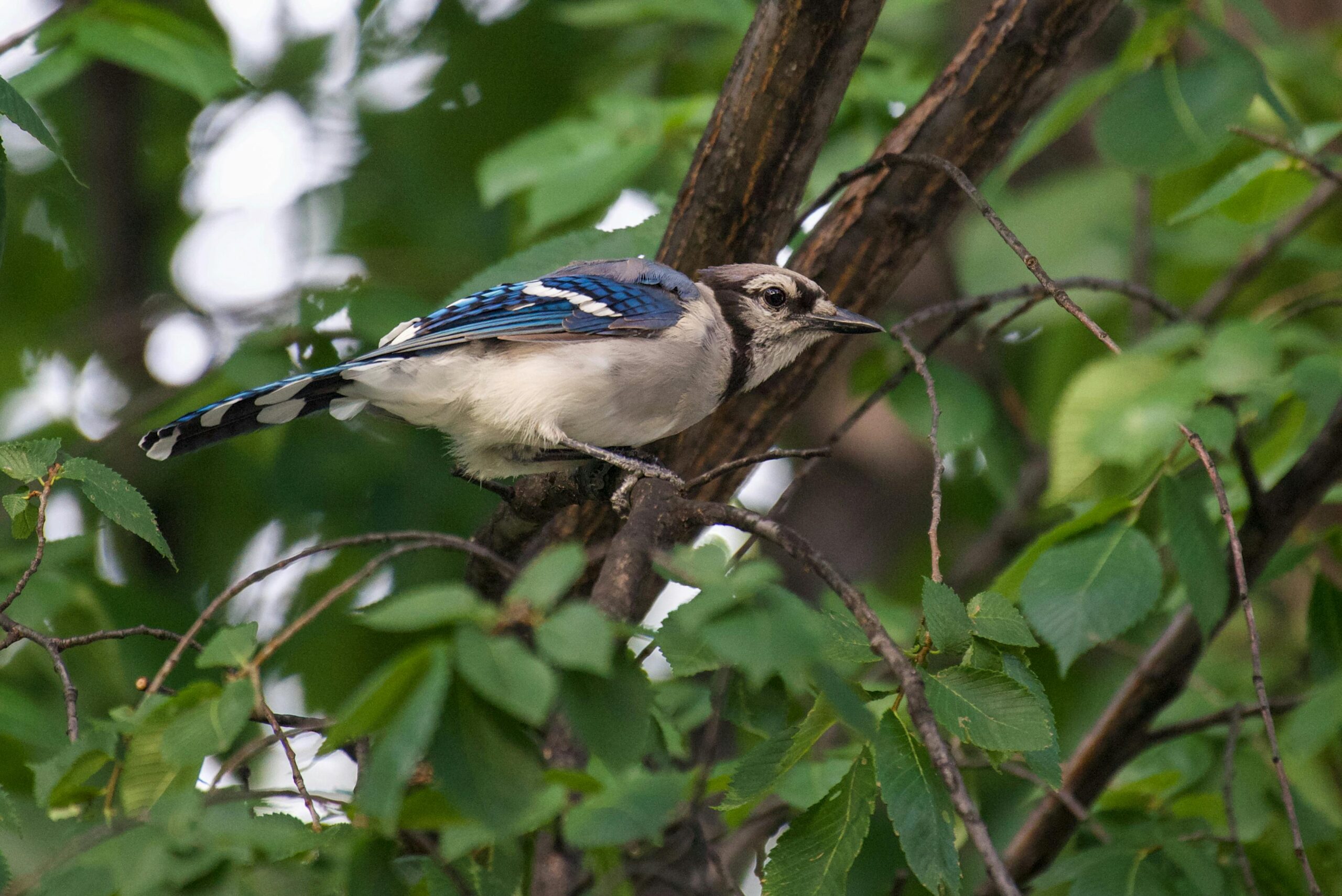
Overview
The Blue Jay (Cyanocitta cristata) is a large North American songbird in the Corvidae family, which also includes crows and ravens. It is native to eastern and central United States and southern Canada, thriving in deciduous and coniferous forests, as well as suburban neighborhoods.
The Blue Jay is a highly intelligent, loud, and strikingly blue songbird native to eastern and central North America, known for its crest, bold behavior, and complex social communication.
Distribution & Habitat
Blue Jays live:
- Across eastern and central North America
- In forests, forest edges, parks, and residential areas
- Year-round in most of their range, though some northern birds migrate unpredictably
They are especially associated with oak forests, thanks to their love of acorns.

Adult Male
Bright blue upperparts: The male has vivid blue feathers on the back, wings, and tail, created by light scattering rather than pigment.
Black “necklace” band: A bold black collar wraps around the neck and face, contrasting with the blue and white.
White underparts: The chest and belly are clean white to pale gray.
Crested head: A tall blue crest that rises when he’s excited or agitated and flattens when calm.
Wing and tail pattern: Distinct black barring and white patches on the wings and tail give a sharp, patterned look.
Adult Female
Blue upperparts: Just like the male, she has bright blue feathers on the back, wings, and tail created by structural coloration.
Black facial markings: A black “necklace” band wraps around the throat and face, though it may appear slightly thinner or softer in some females (not reliable for ID).
White to gray underparts: Her belly and chest are pale white or light gray.
Crested head: A blue crest that rises when she’s alert or agitated and flattens when relaxed.
Wing and tail pattern: Bold black barring with white patches, identical to the male’s pattern.

Size
Length: 9–12 inches,
Wingspan: 13–17 inch,
Weight: 2.5–3.5 ounces
Diet/Foraging
Blue Jays are omnivores. Their diet includes:
- Acorns, nuts, seeds, grains
- Fruits and berries
- Insects and other invertebrates
- Occasionally small vertebrates or eggs, though this is rare (only ~1% of studied stomach contents).
They often cache acorns, helping oak forests spread after the last glacial period.
Breeding & Nesting
Blue Jays build open cup nests in trees. Young stay with parents for 1–2 months after hatching
Clutch size: 2–7 eggs, Both parents participate in nest building and care
Migration
Blue Jay migration is irregular and unpredictable, with some individuals migrating long distances while others stay in place year‑round. In fall, jays may travel in loose flocks along shorelines or forest edges, often moving south when acorn crops are poor, yet the same bird might choose not to migrate the following year. Young jays migrate more consistently than adults, but overall their movements remain one of the more mysterious patterns among North American songbirds.
Behavior
Mimics hawks — Blue Jays can imitate the calls of Red‑shouldered and Red‑tailed Hawks, using the sounds to warn others or to scare birds away from food.
Caches food — They hide acorns, seeds, and nuts in the ground for later use, often forgetting some and helping new trees grow.
Uses crest and calls for communication — Their crest rises when they’re excited or aggressive and flattens when calm, and they use a wide range of calls to signal danger, claim territory, or interact socially.
