Overview
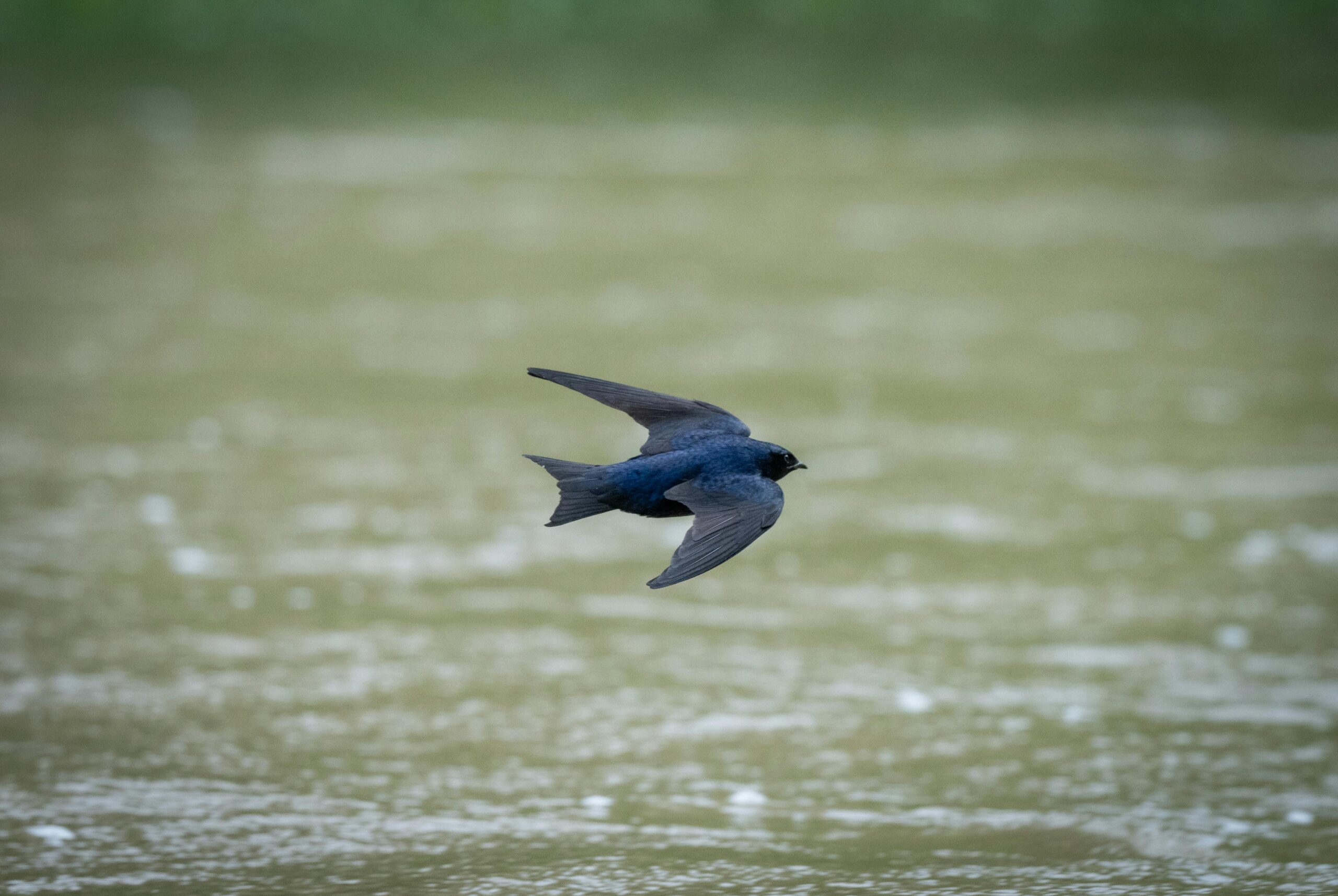
The Purple Martin (Progne subis) is the largest swallow in North America, measuring about 7–8.5 inches long. Males have glossy blackish‑blue iridescent plumage, while females are grayer with lighter underparts. Their plumage isn’t truly purple—its sheen creates the blue‑purple effect.
Distribution & Habitat
Purple Martins breed across most of eastern and central North America, parts of the Pacific Northwest, and southern Canada, and winter in South America—mainly the Amazon Basin. They favor open areas near water, such as fields, lakeshores, meadows, and suburban spaces with good aerial foraging room. In the eastern U.S., they nest almost entirely in human‑provided housing, while western birds still use natural cavities in trees or cliffs.

Adult Male
A red bill, white crescent above the eyes
Purple breast, orange “sails” on the back
Green, bronze, and orange plumage patterns
Adult Female
Gray‑brown feathers
White eye‑ring with a stripe trailing behind
Pinkish bill

Size
Length: 7–8.5 in (18–22 cm)
Wingspan: 15–16 in (38–41 cm)
Weight: 1.6–2.1 oz (45–60 g)
Diet/Foraging
Purple Martins are aerial insectivores, catching all their food in flight. They feed on dragonflies, damselflies, moths, butterflies, beetles, midges, and mosquitoes. They even drink on the wing by skimming water surfaces.
Breeding & Nesting
Purple Martins nest in colonies, usually in man‑made housing, where the female builds a grass‑and‑leaf nest and lays 4–5 eggs. She incubates for 15–18 days, and both parents feed the young until they fledge at about 26–32 days. Martins often return to the same colony sites each year and rely heavily on human‑provided housing in the eastern U.S.
Migration
Purple Martins are long‑distance migrants that travel between North America and the Amazon Basin, leaving their breeding colonies in late summer and returning in early spring. After forming huge pre‑migration roosts, they head south through the Caribbean, Central America, or across the Gulf of Mexico, eventually wintering deep in South America where flying insects remain abundant year‑round. In late winter they begin their return journey, with the earliest birds reaching the southern United States by February and continuing northward through spring. Their migration is driven entirely by the availability of aerial insects, which disappear from northern climates in winter, making this seasonal movement essential for survival.
Behavior
Aerial insect hunter — Catches all food in flight, performing agile swoops and glides over open areas.
Highly social — Lives in colonies, vocalizes constantly, and gathers in massive communal roosts before migration.
Strong site fidelity — Returns to the same nesting colony each year, especially where human‑provided housing is available.
