Overview
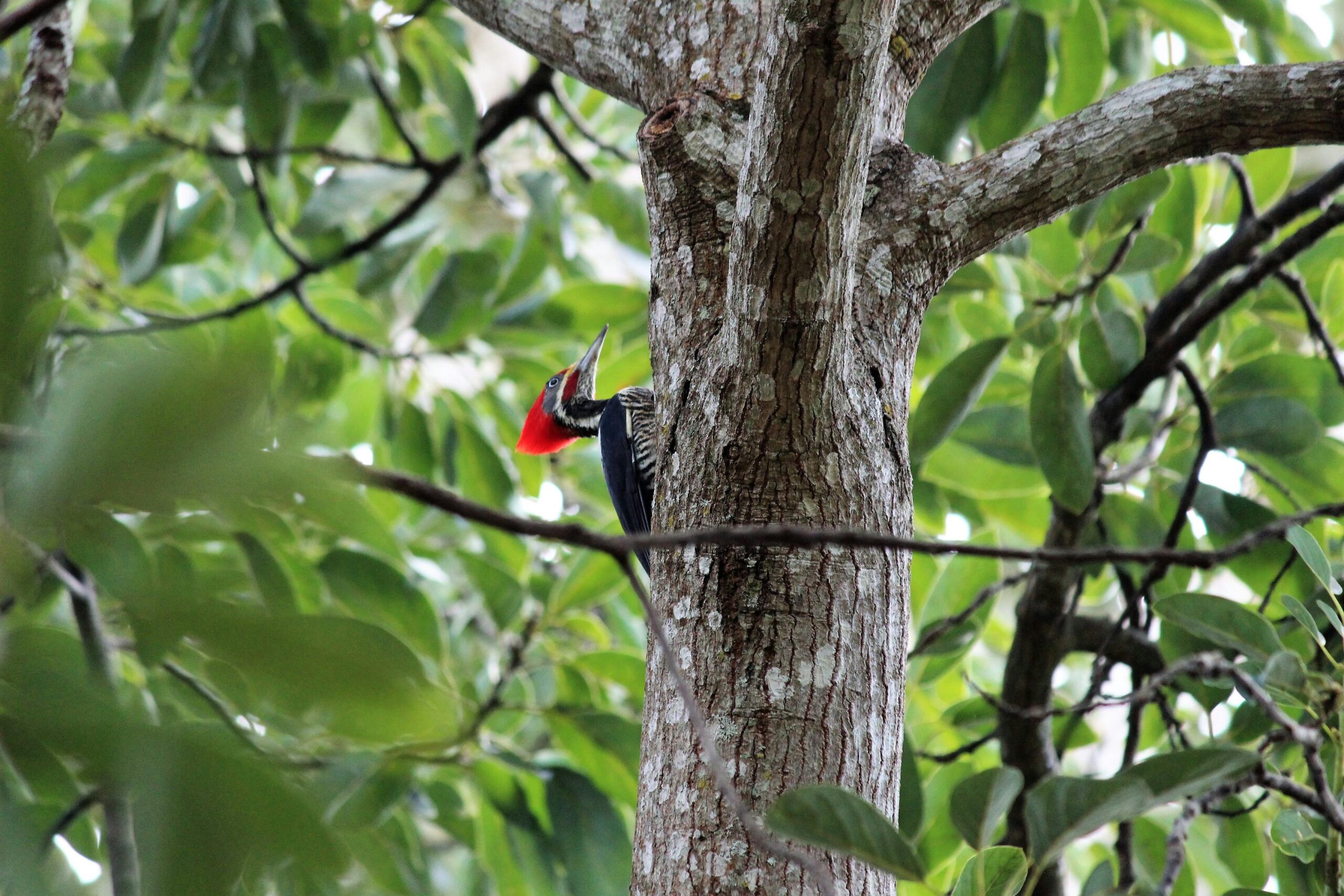
The Pileated Woodpecker (Dryocopus pileatus) is one of the largest woodpeckers in North America, nearly crow‑sized, with a striking red crest, black body, and bold white neck stripes. It is famous for chiseling large, rectangular holes in trees while searching for carpenter ants.
It is native to forested regions across Canada, the eastern U.S., the Great Lakes, and parts of the Pacific Coast.
Distribution & Habitat
Pileated Woodpeckers inhabit mature forests, both deciduous and coniferous, and prefer areas with large trees, deadwood, and downed logs. They occur year‑round across Canada, the eastern U.S., and parts of the Pacific Northwest. They are permanent residents, not migratory.

Adult Male
Large black body with bold white neck stripes
Bright red crest
Red mustache stripe (male‑only)
White underwing patches visible in flight
Long chisel‑like bill
Adult Female
Large black body with bold white neck stripes
Bright red crest
Black mustache stripe (female trait; males have red)
White underwing patches in flight
Long, strong chisel‑like bill

Size
Length: ~16–19 in (40–49 cm)
Wingspan: ~26–29.5 in (66–75 cm)
Weight: ~8.8–14.1 oz (250–400 g)
Diet/Foraging
Their diet is primarily insectivorous, with carpenter ants making up a major portion. They also eat beetle larvae, termites, fruits, and nuts. They excavate deep, rectangular holes to reach insects inside wood.
Breeding & Nesting
Pileated Woodpeckers nest in tree cavities they excavate themselves. They typically lay 4 eggs, and both parents share incubation, with males incubating at night. Their nest cavities are ecologically important, later used by owls, ducks, bats, and other species.
Migration
Pileated Woodpeckers do not migrate. They are year‑round residents across their range, staying on permanent forest territories in both summer and winter. Pairs defend these territories all year, relying on local food sources and cavity roosts even in harsh weather.
Behavior
Powerful drumming on resonant trees for communication and territory defense
Strong, undulating flight typical of woodpeckers
Year‑round territorial pairs that defend large forested territories
