Overview
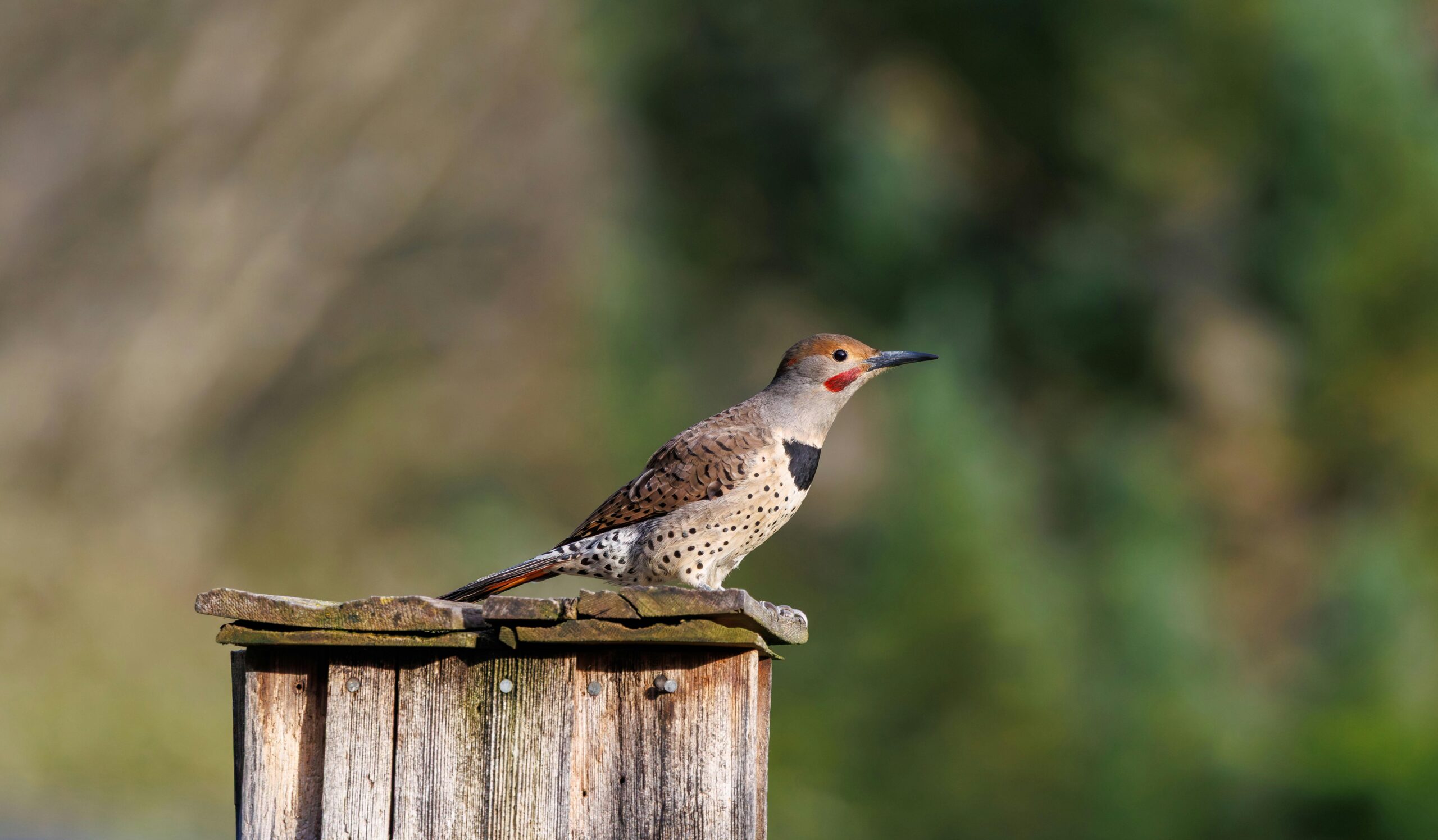
The Northern Flicker (Colaptes auratus) is a widespread North American woodpecker with two main forms: the Yellow‑shafted Flicker in the East and North, and the Red‑shafted Flicker in the West. Both forms share a brown, barred back, spotted belly, and a distinct black chest crescent, but differ in the color of their wing and tail shafts—yellow in the eastern group and red in the western group.
This species is medium‑sized, measuring 11–12 in (28–31 cm) in length, with a wingspan of 17–20 in (43–51 cm) and a weight of 4–6 oz (113–170 g). It is one of the few woodpeckers that migrates, with northern populations traveling south in fall, while others move shorter distances or remain resident.
Distribution & Habitat
Northern Flickers occur from Alaska and Canada through the United States and into parts of Central America, occupying open forests, woodlots, groves, towns, and semi‑open country. They require trees for nesting but often forage in open areas.

Adult Male
Brown body with black barring on the back
Spotted belly and a black chest crescent
Red or black mustache stripe (male‑only)
Bright yellow or red wing and tail shafts (depending on region)
White rump patch visible in flight
Adult Female
Brown body with black barring on the back
Spotted belly and black chest crescent
No mustache stripe (key female trait)
Yellow or red wing/tail shafts depending on region
White rump patch visible in flight

Size
Length: 11–12 in (28–31 cm)
Wingspan: 17–20 in (43–51 cm)
Weight: 4–6 oz (113–170 g)
Diet/Foraging
Northern Flickers are unusual among woodpeckers because they feed primarily on the ground, where they dig into soil and ant mounds using their slightly curved bill. Ants make up around 45% of their diet, and they also consume ground beetles, flies, butterflies, moths, snails, and other invertebrates. Their long, barbed tongue—capable of extending well beyond the bill—helps them extract insects from underground tunnels. scienceinsights.org
When insect availability drops in winter, flickers shift to fruits, berries, and seeds, including dogwood, sumac, wild cherry, grape, bayberry, hackberry, elderberry, sunflower, and thistle seeds. They may also forage in agricultural areas, feeding on pests such as corn borers, which can benefit farmers.
Breeding & Nesting
Northern Flickers nest in tree cavities, usually excavating their own, and both parents share incubation and feeding duties. They lay 5–8 white eggs, incubate for about 11–12 days, and the young fledge at around 3–4 weeks. Flickers often reuse or enlarge old cavities and will accept nest boxes. They typically raise one brood per year, though some southern birds may attempt two.
Migration
Northern Flickers are partial migrants: northern birds migrate south for winter, while many in the central and southern U.S. stay year‑round. Birds from Canada and the northern states move to the southern U.S. and Mexico as temperatures drop and insects become scarce. Migration is generally short‑ to mid‑distance, with birds traveling by day and returning north in early spring. Western Red‑shafted Flickers tend to migrate less than eastern Yellow‑shafted birds, but both show regional variation depending on climate and food availability.
Behavior
Ground‑foraging woodpecker Spends much of its time on the ground digging for ants and beetles—unusual for a woodpecker.
Strong, vocal communicator Uses loud calls (kleeer, wicka‑wicka) and vigorous drumming to claim territory and attract mates.
Cavity‑nesting excavator Both sexes excavate nest cavities in trees or use existing ones, defending them aggressively during breeding.
